
To disclose a conflict of interest in research, identify relevant relationships, check the journal’s requirements, complete the requested forms, and provide a matching manuscript statement. Explain who has the relationship, which organization is involved, and how it relates to the work.
Disclosure of conflict of interest is about transparency, not confessing wrongdoing. Relevant competing interests in research give editors and readers information they need to assess the work fairly.
What Is a Conflict of Interest in Research?
A conflict of interest in research arises when a secondary interest could influence, or reasonably appear to influence, responsibilities such as objective analysis, participant protection, or editorial judgment. Having a relevant relationship does not prove that the research is biased or dishonest.
How to Disclose Conflicts of Interest in Academic Publishing?
Managing a conflict of interest in research starts before journal submission. Institutional reporting, ethics review, and publication declarations may have different purposes and requirements.
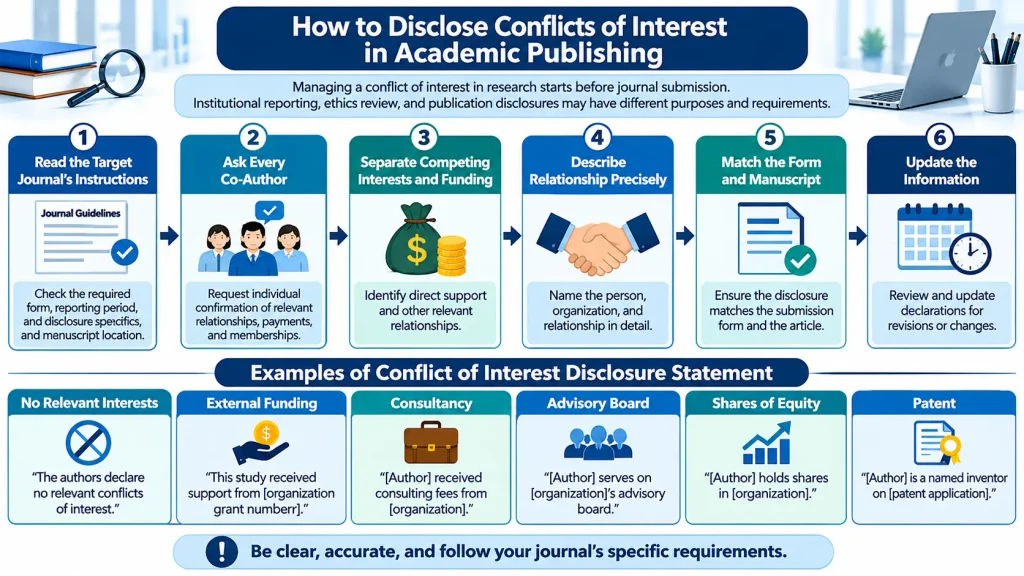
1. Read the Target Journal’s Instructions.
Check the required form, reporting period, relationship categories, and manuscript location. There is no single reporting window or monetary threshold that applies to every journal.
For example, Sage’s policy describes a five-year period before research begins while also requiring disclosure of older interests that may have influenced the work. Do not transfer that rule to another publisher without checking.
2. Ask Every Co-Author
Request individual confirmation of relevant employment, payments, investments, intellectual property, and non-financial relationships. Do not infer another author’s position from a CV or funding acknowledgement.
Where an institutional research conflict of interest policy applies, follow that process separately. A corresponding author should coordinate the information, not decide that a colleague’s relationship is unimportant without discussing it.
3. Separate Competing Interests and Funding
Identify direct support for the study, including grants, equipment, services, or support for an author’s contribution. Broader relationships can require disclosure even when they did not finance this particular project.
State the sponsor’s role in study design, data collection, analysis, writing, and publication decisions. Describe restrictions or data-access arrangements accurately; do not automatically insert “the funder had no role.”
4. Describe Relationships Precisely
Name the author, organization, and relationship. Explain relevant consultancy, ownership, advisory work, or patent involvement instead of writing a vague statement such as “some commercial associations exist.”
Provide amounts or additional details when required by the journal’s form. Avoid unnecessarily publishing another person’s private information; seek editorial advice about sensitive details.
5. Match the Form and Manuscript
Disclosure of conflict of interest may be required both in the submission system and in the article itself. Ensure the two versions agree, and follow instructions for separate or anonymized files.
A cover-letter explanation does not necessarily replace the requested declaration.
6. Update the Information
Review declarations when submitting revisions and before publication. If circumstances change or an omission is discovered, contact the editorial office with the accurate relationship, relevant dates, and affected manuscript.
Keep copies of submitted forms and correspondence so the reporting history is clear.
Actual vs Potential vs Apparent Conflict of Interest
Common causes of conflict of interest include financial rewards, personal relationships, professional loyalties, and organizational responsibilities.
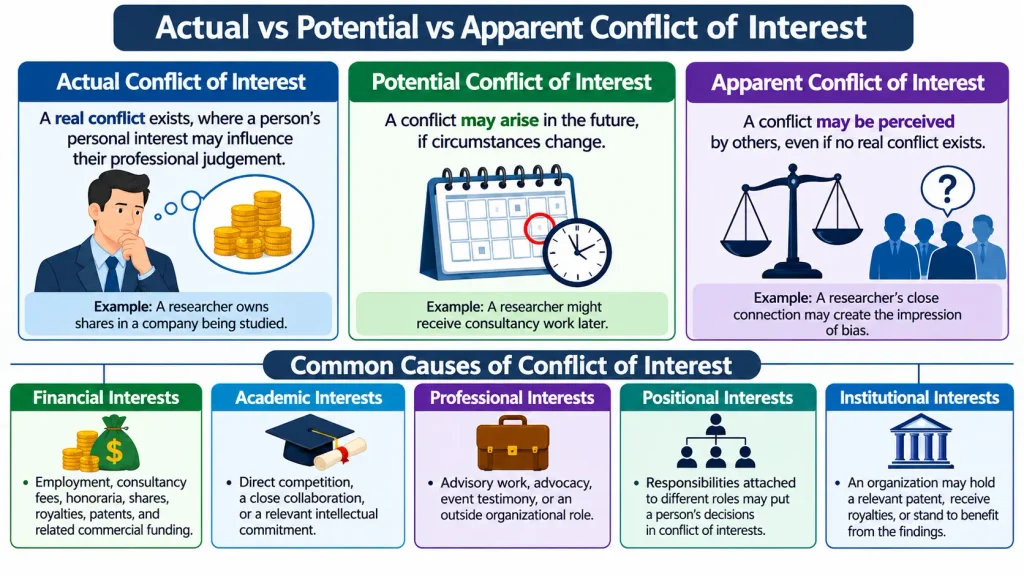
- Financial interests include employment, consultancy fees, honoraria, shares, royalties, patents, and related commercial funding.
- An academic conflict of interest may involve direct competition, a close collaboration, or a relevant intellectual commitment.
- A professional conflict of interest may arise through advisory work, advocacy, expert testimony, or an outside organizational role.
- A positional conflict of interest can arise when responsibilities attached to different roles pull a person towards competing decisions.
- Institutional interests matter when an organization holds a relevant patent, receives royalties, or stands to benefit from the findings.
What are the 3 Types of Conflict of Interest?
The following 3 types of conflict of interest provide a useful working distinction, although institutional terminology varies.
| Situation | Meaning | Hypothetical example |
| Actual conflict of interest | A present interest conflicts with an existing responsibility. | A researcher evaluates a product while owning the company selling it. |
| Potential | A foreseeable development could create conflicting responsibilities. | A researcher is discussing a relevant commercial role that would begin later. |
| Apparent conflict of interest | A reasonable observer could question impartiality, whether or not judgment was affected. | A researcher evaluates a program closely associated with a family member. |
The difference between actual and potential conflict of interest concerns the current situation versus a foreseeable future development—not whether someone has already behaved improperly.
An actual or perceived conflict of interest should be assessed under the applicable policy rather than dismissed because the researcher feels impartial.
Bias vs Conflict of Interest
Bias is a systematic influence on methods, interpretations, or decisions. A relevant relationship creates a risk that judgement could be affected; it does not establish that this happened in a particular study.
The absence of conflict of interest is therefore not proof that a study’s design or conclusions are sound. Disclosure and methodological quality answer different questions.
Examples of Conflict of Interest Disclosure Statement
These are original templates, not journal-approved wording. Replace brackets with accurate details and adapt them to the requested form; use the absence of conflict of interest wording only after every author has checked.
- No relevant interests: “The authors declare no relevant conflicts of interest.”
- External funding: “This study received support from [organization, grant identifier]. Its role was [describe accurately].”
- Consultancy: “[Author] received consulting fees from [organization] for work related to [relevant area].”
- Advisory board: “[Author] serves on [organisation]’s advisory board. The position is [paid/unpaid].”
- Shares or equity: “[Author] holds [shares/options/equity] in [organization], whose interests relate to this study.”
- Patent: “[Author] is a named inventor on [patent/application identifier], concerning [relevant technology]; [describe licensing or royalty interests].”
- Non-financial relationship: “[Author] holds an unpaid role with [organization], which advocates on issues examined here.”
- Sponsor involvement: “[Sponsor] contributed to [specified activities]. [Explain author data access, analytical independence, and publication arrangements].”
Conflicts of Interest in Peer Review and Editorial Decisions
A peer review conflict of interest may involve a close collaborator, family relationship, financial stake, or direct rivalry. Tell the editor before accepting the assignment; some relationships require declining rather than merely disclosing.
Hypothetical example: a reviewer is actively preparing another paper with an author. They should explain that relationship to the journal instead of submitting an assessment and mentioning it afterwards.
Editors should arrange independent handling when their relationships could compromise a decision. An actual or perceived conflict of interest cannot necessarily be managed by adding a declaration while retaining decision-making control.
A professional conflict of interest may also involve supervision or organizational dependence. A positional conflict of interest deserves particular attention when one person controls recruitment, staff progression, and commercial decisions.
Institutions should assess their own stakes as well as individual interests. An academic conflict of interest or institutional financial interest may require oversight beyond the journal’s process; institutional research conflict of interest reporting does not automatically substitute for publication disclosure.
Conflicts of Interest in Human Subjects Research
A conflict of interest in research can affect participant welfare as well as publication. Recruitment incentives, commercial stakes, and sponsor influence deserve attention before recruitment and throughout the study, not only when writing the declaration.
An unpaid advisory position can matter when a researcher evaluates the organization’s program. Declare its relevance and explain any management arrangements rather than assuming unpaid work is exempt.
Similarly, a conflict of interest in engineering ethics can arise when an investigator validates a safety-critical product they helped commercialize. Ownership and commercial roles should be visible; independent testing may be necessary.
The CITI Program lists Conflicts of Interest and Commitment (RCR-Basic) within its responsible conduct course. Training is useful, but it is not a journal declaration or an institution’s management decision.
How to Manage and Prevent Conflicts of Interest?
The causes of conflict of interest can be structural: commercial incentives, supervisory authority, or control over data access. Address those arrangements rather than relying on a statement alone.
Managing competing interests in research may require independent analysis, oversight, reassignment, or recusal. Authors should avoid sponsor agreements that prevent independent data access, interpretation, or publication.
Consequences of Failing to Disclose a Conflict of Interest
An omitted conflict of interest in research is not automatically proof that the findings are false. Nevertheless, deliberate failure to report relationships required by a journal can be serious misconduct under its policies.
If a conflict of interest investigation begins, preserve relevant records, respond factually, and follow the responsible body’s procedures.
Ending Note
Managing a conflict of interest in research requires transparency, accurate disclosure, and adherence to journal and institutional policies. Ultimately, clear disclosure and appropriate safeguards help protect research integrity, reduce the risk of bias, and build trust in academic publishing.
Frequently Asked Questions – FAQs
No. Reporting a conflict of interest in research to an institution does not automatically satisfy a journal’s separate requirements.
Not necessarily. For an authorship conflict in research, resolve contribution and credit questions through the appropriate institutional process.
Check the policy and ask the editor when uncertain. Describe the relationship accurately rather than withholding it solely because you believe it did not affect your judgement.