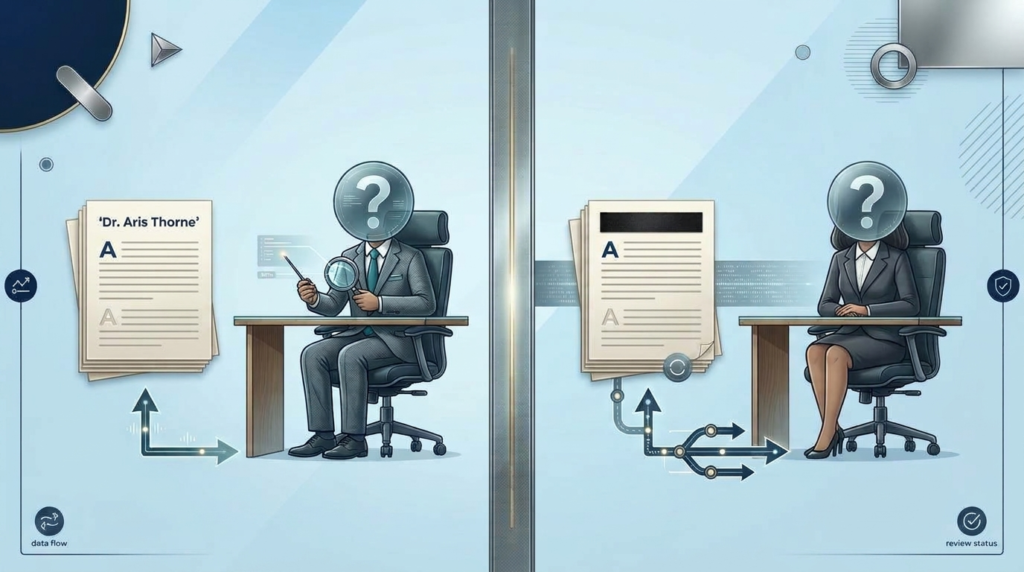
In single blind peer review, reviewers generally know who wrote the manuscript, while authors do not know the reviewers’ identities. In double blind peer review, the process is designed to conceal author and reviewer identities from each other. The difference concerns identity visibility, not the number of reviewers, the number of review rounds, or a guarantee of fair decisions.
What Is Blind Peer Review in Research?
Peer review is an expert assessment of a manuscript’s methods, reasoning, evidence, and suitability for publication. Editors use the reports when making decisions; reviewers advise rather than automatically decide acceptance.
Blind peer review means that certain identities are withheld during that assessment. Many publishers now use single-anonymous, single-anonymized, double-anonymous, or double-anonymized for the corresponding arrangements.
What Is Single Blind Review?
A typical single blind review process begins with editorial screening. The editor selects reviewers, who can usually see author names and affiliations. Reports return through the journal, and authors receive the comments without reviewer names unless the policy permits identification.
Hypothetical Example: A reviewer assessing a survey paper sees the university affiliation and author list. The authors receive comments signed “Reviewer 1,” not the reviewer’s identity.
What Is Double-Blind Peer Review and How Does It Work?
Under double anonymized peer review, reviewers receive a version intended not to identify the authors, while authors normally remain unaware of reviewer identities. The editor or journal staff usually retains the identifying information needed to manage the submission.
Hypothetical example: The same survey paper reaches reviewers without names, affiliations, or identifying acknowledgements.
The intended advantage is to focus attention on the manuscript rather than who produced it. Limitations include preparation time, information that must be handled separately, and the possibility that reviewers recognize the study anyway. Double anonymous peer review is an identity-management arrangement, not a certification that bias has disappeared.
Single-Blind vs Double-Blind Peer Review – Key Differences
The comparison below describes typical arrangements, subject to the journal’s policy and permitted disclosures.
| Comparison | Single-blind review | Double-blind review |
| Author identity visible to reviewer | Generally yes. | Intended to be concealed, but may be inferred. |
| Reviewer identity visible to author | Generally no, unless disclosure is permitted. | Generally no, unless disclosure is permitted. |
| Editors and submission staff | Normally know the author and assigned reviewers. | Normally still know the author and assigned reviewers. |
| Main identity safeguard | Reviewer identity withheld from authors. | Both parties’ identities withheld from each other. |
| Potential strengths | Candid feedback; author context available. | Reduces some opportunities for identity-based judgement. |
| Potential limitations | Reputation or affiliation can influence assessment. | Imperfect anonymization; additional preparation; some clues remain. |
| Author preparation | Follow ordinary submission and disclosure requirements. | Prepare anonymized files and separate identification as instructed. |
The two models often share the same broad workflow: submission, editorial screening, reviewer selection, reports, possible revisions, and an editorial decision. Double-blind review adds author-anonymization requirements.
Editors remain responsible for managing expertise, competing interests, and inappropriate reports. A decision need not follow a simple majority of reviewer recommendations. Hiding names is not a replacement for those responsibilities. If a reviewer recognizes a possible competing interest, they should notify the editor rather than assume masking removes the conflict.
Are Blind Peer-Reviewed Publications Truly Anonymous?
Not always. Names may be removed while clues remain in the manuscript: self-citations, a distinctive dataset, a named laboratory, an unusual field site, a conference presentation, or an identifiable public preprint. Reviewers in a small specialty may recognize the work.
What Are the Advantages and Disadvantages of Double-Blind Peer Review?
The advantages of double blind peer review are best described as potential safeguards: less direct exposure to author reputation or affiliation, and a stronger expectation that reviewers explain their judgement through the work itself.
There is evidence that identity information can matter. A controlled study at the 2017 Web Search and Data Mining conference found reviewer recommendations differed according to access to author and institutional information. Single-blind reviewers were more positive about work associated with famous authors and high-prestige institutions.
How to Prepare a Manuscript for Double-Blind Peer Review?
1. Confirm the Exact Submission Arrangement
Check whether the journal uses or offers double-blind review, which files reviewers receive, and whether the option must be selected. Do not assume selecting a box anonymizes the uploaded document.
2. Separate Identification as Instructed
Remove author names, affiliations, and identifying headers from the reviewer-facing manuscript where required. Place identifying information in the designated title page, cover letter, or submission fields, not an improvised location.
3. Handle Declarations Without Concealing Required Information
Funding, acknowledgements, contributions, ethics details, and competing-interest statements can reveal identity. Follow the journal’s relocation or masking instructions while preserving required disclosures for the editor.
4. Review Self-Citations Honestly
Use neutral third-person wording for your own earlier work. Preserve scholarly attribution and follow the specific rules on identifying references or placeholders. Do not imply someone else created your work, invent a citation, or omit a necessary source simply to conceal authorship.
5. Inspect Every Reviewer-Facing File
Check document properties, author metadata, comments, tracked changes, filenames, figures, supplementary materials, and repository links. A clean first page does not guarantee that the PDF or its supporting files are anonymous.
6. Check the Uploaded Version
Review the compiled submission or preview and its file designations. Confirm that the identifying title page is not included in the reviewer copy. Repeat checks after revision, when response letters and new supporting files may introduce fresh clues.
Which Academic Journals Use Double-Blind Peer Review?
A double blind peer review journal may use the model as its default or offer it as an option. Policies differ by journal, discipline, and article type, so always check the submission instructions.
For example, some Nature journals offer double anonymized peer review on request, while many IEEE publications use single-anonymous review. A double blind peer review journal list can become outdated, so treat it as a starting point rather than a final answer.
Why “Blind” Is Sometimes Called “Anonymized”?
The blind peer review meaning is simple: some identities are hidden during assessment. However, many publishers now prefer single anonymized peer review and double anonymized peer review because these terms describe the process more precisely.
So, what is a double blind peer review? It is a review process where author and reviewer identities are intended to remain hidden from each other. A double blinded review and a double blind review mean the same thing in everyday academic use.
What Are the Different Types of Peer Review?
Beyond single and double models, journals may use several peer review categories:
- Triple-anonymous review: Author, reviewer and editor identities are concealed.
- Open peer review: Reviewer identities may be known, and reports may be public.
- Transparent peer review: Reports or decision letters are published, but reviewer names may stay hidden.
- Transferable review: Reviews may move with a manuscript to another journal in the same publisher group.
These are different types of academic reviews and peer review categories, not fixed universal rules. The number and naming of kinds of peer review vary between publishers.
How to Ensure Anonymity During Blind Peer Review?
Ensuring a blind review means checking more than the title page. Remove or separate author details, check file metadata, review supplementary files, and inspect the final uploaded PDF.
A proper double blind submission also keeps required funding, ethics, and conflict-of-interest disclosures available to the editor. Anonymising the reviewer file should never involve hiding necessary information or making misleading claims.
Peer Review vs. Non-Peer Review – What Is the Difference?
Peer review vs non peer review is another useful distinction. Peer-reviewed content has been assessed by independent experts before publication; non-peer-reviewed content, such as some editorials, news items or preprints, may not have undergone the same process.
Also, peer review vs literature review is not the same comparison. Peer review evaluates a manuscript; a literature review summarizes existing research.
Nature Communications and IEEE Double-Blind Peer Review Policies
Nature Communications’ author instructions describe requesting double-anonymized peer review during submission and make manuscript anonymization the authors’ responsibility. Its model should not be inferred merely from the journal’s name or from a general Nature-wide statement. Policies were checked on 5 November 2026.
For IEEE double-blind review, check the actual publication or event. IEEE’s general journal guide says most of its publications use single-anonymous review, while the TCRTS requirements page describes double-anonymous arrangements for RTSS and RTAS. The latter page is dated May 2023; consult the current event instructions before applying it.
A double blind peer review journals list can become outdated. Verify the journal’s own instructions, whether the model is optional, and the rules for the intended article type.
What Are the Types of Peer Review
There is no universal list of seven categories because models vary along several dimensions: identity, timing, report publication, and interaction.
- Open peer review commonly reveals reviewer identities to authors, but the timing and public visibility vary.
- Transparent peer review publishes elements such as reports and responses; reviewer names may remain hidden.
- Post-publication peer review occurs after an article is available and may coexist with earlier assessment.
- Collaborative review involves interaction among reviewers or between reviewers and authors, depending on the model.
- Triple-anonymous approaches can extend masking to decision-making editors, but implementations differ.
Peer review vs literature review is a different comparison. Peer review evaluates a submitted work; a literature review synthesises scholarship. Likewise, original articles, systematic reviews and case reports are article categories—not identity models.
Single-Blind vs. Double-Blind Review – Which Is Better?
Neither is universally superior. Consider the journal’s relevance, editorial standards, reviewer selection, conflict management, transparent policies and practical implementation alongside its identity model.
Independent pre-submission peer review is advisory feedback before journal assessment. It is not the journal’s review, does not determine its anonymity policy, and cannot guarantee acceptance.
End Note
Know who should see each identity, which files carry identifying details, and what may later be published. Verify the reviewer-facing version, preserve required disclosures, and keep the research understandable.
Frequently Asked Questions
Some are, but not all. Single- and double-anonymous models usually hide reviewer identities from authors; open models may reveal them under specified conditions.
Not necessarily. “Double peer review” is ambiguous; double-anonymous review concerns concealed identities, not a fixed reviewer count or two mandatory rounds.
Not always. Published reports can be anonymous, while open identity does not necessarily mean every report or confidential exchange is public. Read the policy.
They may make authors easier to identify, but they are not universally prohibited. Check the venue’s preprint and publicity rules rather than assuming one rule applies everywhere.
No. Open access concerns access to published content. It does not tell you whether or how that content was peer-reviewed.
Not necessarily. Editorials, news, corrections, and other content may have different procedures. Check the journal’s policy for the specific article type.