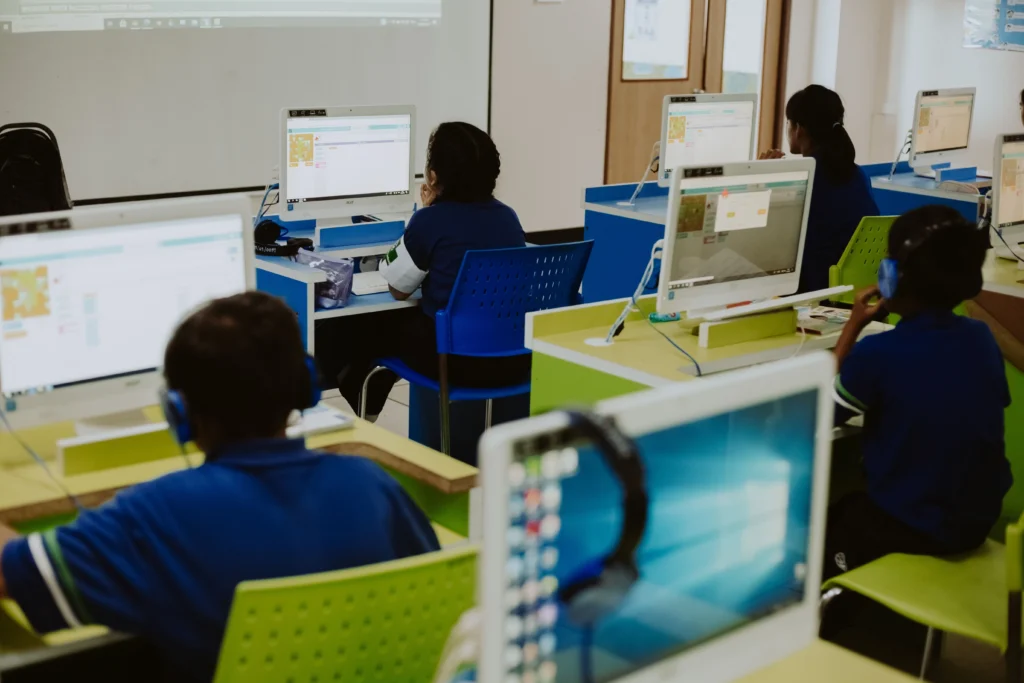
Digital technology in education is no longer a supplementary add-on; it has fundamentally restructured what happens inside a classroom, who delivers learning, and how students engage with content. According to a 2023 UNESCO report, over 90% of countries now incorporate digital tools in formal education policy. Yet the real story is not simply about adoption rates. It is about how technology-enhanced learning is reshaping the cognitive, social, and institutional dimensions of education in ways that were unimaginable two decades ago.
This article draws on peer-reviewed research, institutional frameworks, and documented outcomes to provide an authoritative, evidence-based overview of how digital technology is reshaping modern classrooms and where the field is heading.
The Shift From Passive to Active Learning Environments
Traditional classroom architecture placed the teacher at the centre, the primary source of information, pacing, and feedback. Digital learning environments have disrupted this model by enabling students to interact directly with content, at their own pace, and with immediate feedback loops that no human instructor can replicate at scale.
Learning management systems (LMS), such as Canvas, Blackboard, and Moodle, now serve over 500 million learners globally, according to Datareportal’s 2024 Digital Learning Index. These platforms do more than host course materials; they generate granular data on student engagement, completion rates, time-on-task, and assessment performance. Instructors who use this data effectively can identify struggling students weeks before a traditional assessment would surface the problem.
Interactive classroom technology, including digital whiteboards, student response systems, and gamified learning platforms such as Kahoot and Nearpod, has demonstrably improved active participation. A 2022 meta-analysis published in the British Journal of Educational Technology found that interactive digital tools increased student engagement rates by an average of 28% compared to lecture-only formats.
Key Digital Learning Tools and Their Measured Impact
| Technology Tool | Primary Function | Documented Outcome | Source |
| Learning Management Systems (LMS) | Course delivery, assessment, analytics | 22% improvement in on-time submission rates | EDUCAUSE 2023 |
| Adaptive Learning Platforms | Personalised content pacing | 31% better test score outcomes vs. fixed pacing | Gates Foundation 2022 |
| Interactive Whiteboards | Collaborative visual engagement | 28% increase in active participation | BJET Meta-Analysis 2022 |
| Video-Based Learning | Flipped classroom, on-demand content | 40% reduction in foundational knowledge gaps | Pearson Education 2023 |
| AI-Powered Tutoring | Personalised feedback, gap analysis | Equivalent to a 2-sigma effect of 1:1 tutoring | Carnegie Learning Studies |
Personalised Learning at Scale
One of the most significant promises of digital technology in education is personalised learning, the ability to tailor content, pace, and assessment to each student’s demonstrated knowledge level. Until recently, true personalisation was impossible at scale; a teacher managing thirty students cannot reasonably deliver thirty individual learning paths simultaneously.
Adaptive learning platforms now make this feasible. Systems like DreamBox Learning, Knewton, and Carnegie Learning use machine learning algorithms to continuously assess where each student is, what they already understand, and what they need to encounter next. The platform responds in real time, presenting an easier worked example when a student stalls or accelerating content when mastery is demonstrated.
The implications for equity are substantial. Students who have historically been left behind in pace-standardised classrooms, whether because the pace is too fast or too slow, gain access to a learning trajectory calibrated to their actual starting point. Research from the RAND Corporation’s Personalised Learning initiative found that students in schools implementing technology-driven personalised learning gained, on average, three additional months of learning in mathematics compared to peers in traditional settings.
Remote and Hybrid Learning as a Structural Shift
The COVID-19 pandemic compressed what might have been a decade of gradual adoption into eighteen months of forced implementation. Institutions that had never considered remote or hybrid learning frameworks found themselves building them overnight. The outcomes were uneven, highlighting both the potential and the persistent inequities in digital learning access.
Post-pandemic, remote and hybrid learning have remained structurally embedded in higher education, particularly. According to IPEDS data analysed by the National Center for Education Statistics, as of 2024, approximately 60% of undergraduate students in the United States enrolled in at least one online course in the previous academic year. This is not a temporary accommodation; it reflects a permanent expansion of how and where education occurs.
Virtual learning platforms have matured significantly. Zoom for Education, Microsoft Teams for Education, and Google Classroom now offer features, breakout rooms, collaborative document editing, and asynchronous feedback tools that meaningfully replicate collaborative classroom experiences in distributed settings. The quality gap between in-person and well-designed hybrid learning has narrowed considerably, though it has not closed entirely.
Artificial Intelligence and the Next Frontier
Artificial intelligence applications in education represent the most consequential emerging layer of digital transformation. AI in education currently operates across three primary functions: intelligent tutoring systems, automated assessment and feedback, and predictive analytics for student success.
Intelligent tutoring systems, the most developed AI application in education, have been studied extensively. Landmark research by Benjamin Bloom in 1984 established that one-on-one human tutoring produces learning improvements averaging two standard deviations above traditional instruction. Contemporary AI tutoring systems have been shown to replicate between 0.7 and 1.2 sigma of this effect, which is remarkable given that they operate simultaneously across thousands of students.
Automated feedback systems, increasingly used in writing instruction, provide students with immediate, structured feedback on drafts without requiring teacher time for every revision cycle. Studies from Stanford’s Learning Analytics research group found that students who received AI-assisted feedback completed on average 2.3 more revision cycles per assignment compared to those receiving only end-point instructor feedback, producing measurably better final work.
Predictive analytics, using LMS engagement data, prior academic performance, and demographic factors, can now flag students at risk of course failure up to eight weeks before the end of a semester, giving institutions time to intervene. Georgia State University’s implementation of this approach reduced its summer melt rate by 21% and contributed to a 25% improvement in on-time graduation for first-generation students.
For readers engaged in advancing scholarship in this area, the research published through our [digital education technology](https://scholarlysummit.com/journals/deei) journal provides peer-reviewed frameworks and empirical studies that inform both policy and practice.
Smart Classroom Solutions and the Physical Environment
Digital transformation in education does not exist only in software. The physical classroom is also being reimagined through smart classroom solutions, integrated systems that combine IoT sensors, responsive lighting, air quality monitoring, and connected audiovisual infrastructure to create learning environments optimised for attention and comfort.
Research from the University of Salford’s HEAD Project (Holistic Evidence and Design) demonstrated that well-designed learning environments, including appropriate lighting, temperature, air quality, and flexible furniture, can account for up to 16% of the variation in academic progress. Smart classroom infrastructure allows these variables to be managed dynamically rather than fixed at construction.
Institutions implementing full smart classroom ecosystems report secondary benefits, including improved attendance rates, reduced energy consumption, and more effective space utilisation, particularly relevant as institutions manage the push-pull between in-person and hybrid learning demands.
Challenges That Remain Unresolved
The trajectory of digital technology in education is not uniformly positive. Three challenges persist that require honest acknowledgement.
The digital divide remains real. Despite widespread adoption at the institutional level, access at home, in terms of both devices and reliable internet connectivity, remains deeply unequal. UNESCO estimates that 700 million school-age children globally still lack access to adequate home digital infrastructure for remote learning participation.
Screen time and attention fragmentation present legitimate pedagogical concerns. Research on multitasking in learning environments consistently shows that the presence of internet-connected devices in classrooms, if not structured carefully, reduces retention and increases cognitive load through distraction.
Data privacy and algorithmic transparency are unresolved governance challenges. The volume of student data collected by LMS platforms and adaptive systems raises serious questions about consent, storage, use, and the potential for algorithmic bias in educational recommendations.
What the Evidence Recommends
The body of evidence on digital technology in education points toward a nuanced conclusion: technology does not inherently improve learning, but thoughtfully implemented technology, aligned with sound pedagogical principles, measurably does.
The most effective implementations share common characteristics. They use technology to enable active rather than passive engagement. They generate data that instructors actually use to adapt their teaching. They maintain human relationships as the emotional foundation of learning, using technology to extend rather than replace instructor presence. And they are implemented with explicit attention to equity, ensuring that access to digital learning advantages is not stratified by socioeconomic status.
FAQs – Frequently Asked Questions
1: What is the most impactful digital technology in education today?
Adaptive learning platforms and AI-powered tutoring systems currently show the strongest evidence for improving student outcomes at scale, particularly in mathematics and literacy.
2: Does digital technology replace teachers?
No evidence suggests that digital technology effectively replaces skilled teachers. The strongest outcomes occur when technology handles personalisation and data analysis while teachers focus on mentorship, complex facilitation, and emotional support.
3: How do schools address the digital divide?
Leading approaches include device lending programmes, partnering with local internet providers for subsidised home access, and designing digital learning components that can function offline or with low-bandwidth connectivity.
4: Are there risks to using AI in education?
Yes. Risks include data privacy concerns, potential for algorithmic bias in content recommendations, over-reliance on automated feedback at the expense of human judgement, and unequal access to AI-enhanced tools.
Further Reading
Read more in our digital education technology for deeper scholarly exploration of this topic