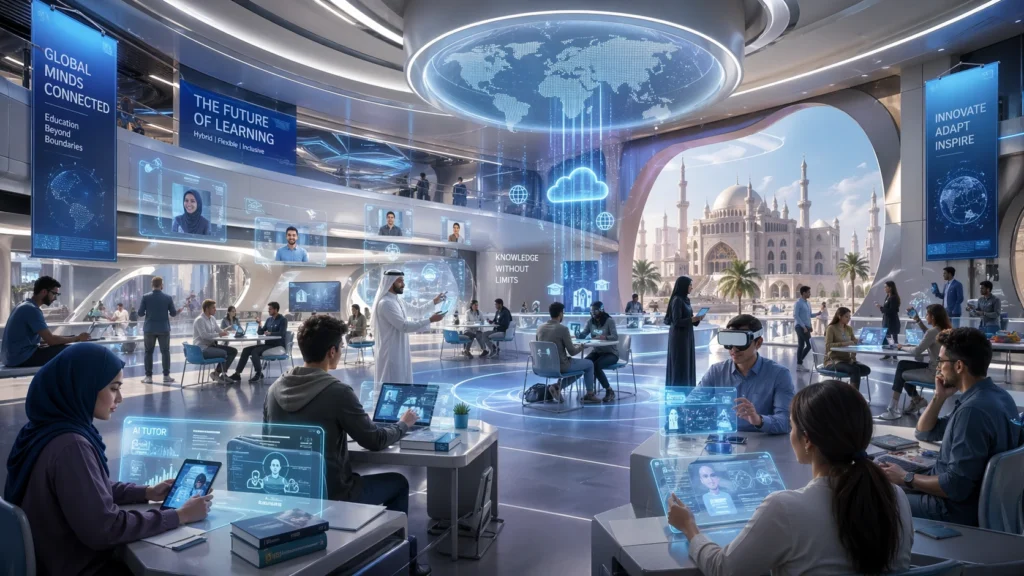
The global higher education landscape has undergone a structural shift following the COVID-19 pandemic, marking a defining phase in Post-COVID Era Higher Education. Institutions have transitioned from emergency remote delivery to long-term digital transformation in higher education, reshaping pedagogy, governance, and student engagement through scalable and technology-driven systems.
This blog further focuses on technological campus overhaul, institutional modernization, and regional dynamics within the Middle East, alongside emerging student learning behaviour trends that are redefining engagement and content delivery. The analysis also highlights implications for workforce alignment, skills-based education, and sustainable planning within modern higher education systems.
Presented in the context of the Scholarly Summit, this discussion positions higher education not merely as a recovering sector but as a re-engineered ecosystem shaped by innovation, hybrid learning models, and long-term academic resilience in a rapidly evolving global knowledge economy.
Post-COVID Higher Education & Digital Transformation
The pandemic did not merely disrupt education; it redefined its operating logic. Universities were compelled to re-evaluate long-standing models of instruction, assessment, and campus engagement. What emerged was not a temporary adjustment but a foundational reconfiguration within Post-COVID Era Higher Education systems.
The Educational historical context of higher education shows that previous technological transitions, such as the introduction of online learning platforms in the early 2000s, were incremental. In contrast, the COVID-19 disruption forced rapid digital transformation in higher education, accelerating adoption across teaching, governance, and student services. Institutions that once relied heavily on physical presence had to adopt digital-first models almost overnight, resulting in deep systemic institutional change across academic structures.
This transition has also reshaped expectations around learning delivery, leading to a broader rethinking of institutional resilience, accessibility, and innovation within modern university ecosystems.
Institutional Transformation and Systemic Realignment
One of the most significant outcomes has been systemic institutional change across governance structures, teaching methodologies, and administrative processes. Universities are no longer isolated academic entities; they are integrated knowledge ecosystems influenced by technology, industry, and global mobility.
This shift is closely tied to digital transformation in higher education, where institutions have embedded data analytics, cloud-based learning platforms, and AI-assisted academic support into their core operations. The result is a more responsive and scalable educational infrastructure.
In parallel, universities have had to rethink funding models, partnerships, and internationalization strategies. The emphasis is increasingly on resilience, adaptability, and long-term relevance rather than short-term enrollment gains.
Technological Acceleration and Campus Reconfiguration
The pandemic accelerated a technological campus overhaul, pushing universities to modernize physical and digital infrastructure simultaneously. Traditional lecture halls are being redesigned into flexible learning environments equipped with interactive technologies.
This transformation aligns with the rise of smart campus technology, where IoT systems, digital attendance tracking, and AI-powered resource allocation are becoming standard. Campuses are evolving into hybrid ecosystems that blend physical presence with virtual engagement.
The adoption of EdTech integration has further enabled institutions to streamline administrative workflows and enhance student support systems. Learning management systems are now central to academic delivery rather than supplementary tools.
Hybrid Learning and Pedagogical Redesign
A defining feature of the post-pandemic era is the normalization of hybrid learning models. These models combine synchronous in-person instruction with asynchronous digital learning, offering flexibility without compromising academic rigor.
This shift has also enabled personalized learning pathways, allowing students to progress at variable speeds based on competency rather than fixed timelines. Adaptive learning platforms now play a crucial role in tailoring content to individual student needs.
As universities refine their instructional strategies, the integration of industry aligned curriculum has become more prominent. Academic programs are increasingly designed in collaboration with employers to ensure relevance in a rapidly changing labor market.
Student Experience and Behavioral Transformation
Student expectations have evolved significantly. There is a noticeable change in Content consumption shifts, with learners preferring short-form, interactive, and digitally accessible academic materials. Traditional textbook-centric learning is gradually being supplemented by multimedia and simulation-based content.
This evolution is closely connected to student learning behaviour trends, where attention spans, engagement patterns, and digital fluency are reshaping how education is delivered and consumed.
In this context, universities are also prioritizing skills-based education, focusing on practical competencies over purely theoretical knowledge. This approach supports the development of adaptable learners capable of navigating uncertain economic environments.
The Middle East Higher Education Landscape
The Middle East has emerged as a significant hub for educational innovation and reform. Investments in infrastructure, policy reform, and international partnerships are reshaping the sector.
The concept of Middle East higher education ROI reflects the growing focus on measurable outcomes such as employability, research impact, and economic contribution. Governments and institutions are increasingly evaluating education through a return-on-investment lens.
In the UAE specifically, UAE higher education trends indicate a strong shift toward digital readiness, international accreditation, and workforce alignment. The emphasis is on producing graduates who can contribute immediately to knowledge-based economies.
Initiatives such as Dubai KHDA digital standards have introduced structured frameworks for digital quality assurance in academic institutions. Similarly, the development of Sharjah University City digital hubs has strengthened the region’s position as a regional education and innovation cluster.
These developments contribute to a broader Sharjah academic ecosystem, where collaboration between universities, research centers, and industry partners is becoming increasingly integrated.
Workforce Alignment and Economic Integration
Higher education is now closely tied to labor market outcomes. The focus on career-ready graduates UAE reflects national priorities around employability and economic diversification.
Universities are increasingly evaluated on their contribution to UAE graduate workforce readiness, ensuring that graduates possess not only academic knowledge but also practical skills aligned with market demands.
This shift is reinforced through industry aligned curriculum development, where academic programs are co-designed with employers. The goal is to bridge the gap between theoretical instruction and real-world application.
At the same time, Dubai university innovation initiatives are fostering experimentation in pedagogy, research commercialization, and startup incubation, reinforcing the city’s position as a global education hub.
Digital Ecosystems and Smart Education Models
The emergence of smart campus technology has redefined how institutions manage learning environments. From AI-driven scheduling systems to predictive analytics for student performance, technology is embedded at every level of university operations.
This transformation is supported by EdTech integration, which enables seamless connectivity between students, faculty, and administrative systems. The result is a more efficient and data-informed academic ecosystem.
Additionally, universities are increasingly adopting hybrid classroom infrastructure, ensuring continuity of learning across physical and virtual spaces. This infrastructure has become essential for maintaining academic stability in uncertain global conditions.
Strategic Outlook and Future Academic Trajectories
Looking forward, universities are moving toward sustainable academic projections that emphasize long-term resilience, inclusivity, and technological adaptability. Sustainability in this context extends beyond environmental concerns to include financial stability and pedagogical relevance.
The future of higher education will also depend on continuous adaptation to UAE higher education trends, which emphasize innovation, internationalization, and digital competitiveness.
Institutions are expected to further refine skills-based education frameworks, ensuring alignment with emerging industries such as artificial intelligence, renewable energy, and digital finance.
At the same time, global institutions must remain responsive to evolving digital transformation in higher education, which continues to redefine institutional boundaries and learning methodologies.
Conclusion
The post-pandemic era has permanently altered the structure and purpose of higher education. Universities are no longer solely centers of knowledge transmission; they are dynamic ecosystems of innovation, workforce development, and digital engagement.
The evolution of the Post-COVID era higher education landscape reflects a broader shift toward flexibility, technology integration, and outcome-based learning. Institutions that embrace these changes are better positioned to remain relevant in an increasingly competitive global environment.
As discussed in the Scholarly Summit, the challenge ahead is not merely recovery but reinvention. Higher education must continue to evolve in response to technological, economic, and societal shifts. The future will belong to institutions that can balance tradition with transformation, ensuring that education remains both accessible and impactful in a rapidly changing world.