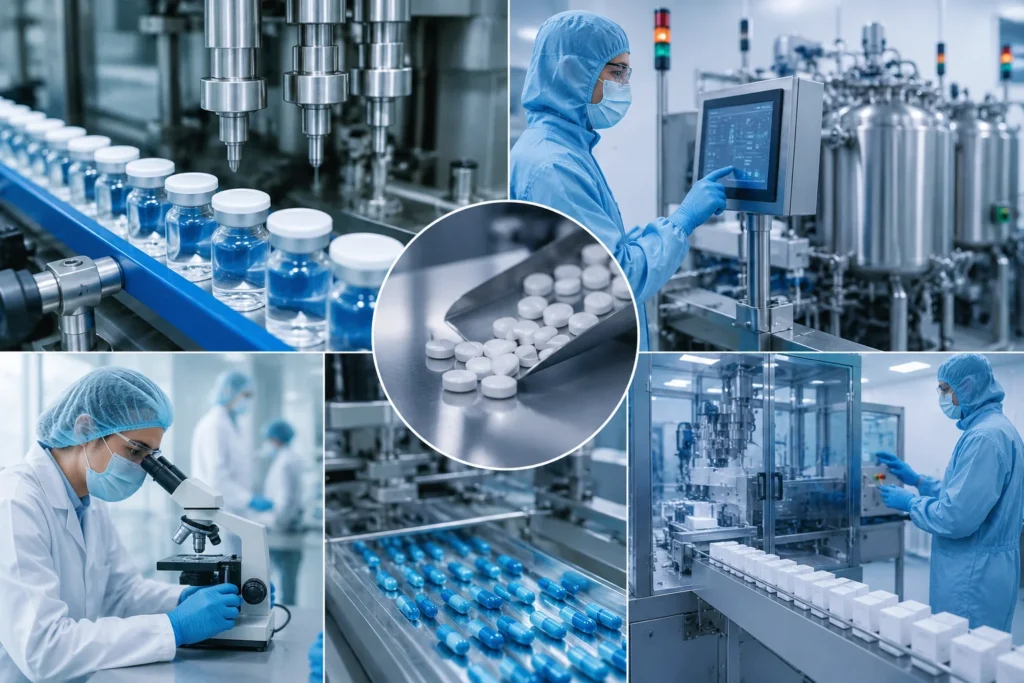
The pharmaceutical industry faces a difficult challenge. Its primary mission is to protect and improve human health, yet the industrial scale of its global operations leaves a substantial environmental footprint. From the intense energy demands of chemical synthesis to the management of highly regulated biochemical waste, the traditional path to drug development strains ecological resources.
Driven by shifting regulatory frameworks, rising operational costs, and an urgent need for environmental stewardship, the global life sciences sector is restructuring its operations. Integrating sustainable pharmaceutical manufacturing is no longer viewed as an optional corporate responsibility initiative; it has become an operational necessity. For senior leadership, manufacturing heads, and regulatory strategists, adopting sustainable manufacturing processes is the primary path to future-proofing global supply chains and reducing the industry’s long-term environmental impact in pharma.
Reshaping the Industrial Footprint of Global Healthcare
Meeting global healthcare demands requires massive production volumes, which inherently create significant industrial waste. Historically, the manufacturing of active pharmaceutical ingredients (APIs) has relied heavily on resource-intensive workflows, high-volume organic solvent consumption, and extensive purification steps.
[Traditional Linear Production] ──> High Input ──> Intense Energy ──> High Chemical Waste
│
▼
[Sustainable Circular Model] ──> Optimized Input ──> Green Energy ──> Material Recovery & Recycling
True pharmaceutical sustainability practices go far beyond standard corporate emissions offsetting. They require a fundamental redesign of industrial operations, a commitment to green pharmaceutical production, and a willingness to evaluate the lifecycle of a therapeutic product from the initial chemical synthesis to the final patient delivery system. By addressing these foundational challenges, forward-thinking manufacturers are proving that clinical efficacy and ecological balance can exist together.
The Innovative Shift to Green Chemistry Principles
At the foundational level of pharmaceutical production lies molecule synthesis. This is where the environmental impact in pharma is most concentrated, and it is also where the most meaningful improvements are taking place.
Moving Away from Resource-Intensive Synthesis Techniques
Traditional chemical synthesis often requires multi-step reactions that utilize vast quantities of hazardous organic solvents, heavy metal catalysts, and intense thermal energy. The metric used to evaluate this efficiency is the Environmental Factor (E-factor), which measures the mass of waste generated per kilogram of desired product. In traditional API manufacturing, it is common to see an E-factor where a single kilogram of medicine creates over one hundred kilograms of industrial waste.
Implementing Biocatalysis and Earth-Abundant Systems
To drive reducing industrial pharmaceutical waste, manufacturers are increasingly integrating the principles of green chemistry in pharmaceuticals. This transition involves replacing toxic synthetic catalysts with highly targeted biological enzymes.
- Enzymatic Biocatalysis: Using engineered enzymes allows chemical reactions to occur at ambient room temperatures and in water-based solutions, eliminating the need for volatile, petroleum-derived organic solvents.
- One-Pot Syntheses: Streamlining production by running multiple sequential reactions inside a single manufacturing vessel. This process significantly reduces intermediate isolation steps, saves hours of cleaning time, and curtails total solvent consumption.
- Renewable Feedstocks: Shifting raw material sourcing away from finite petrochemical derivatives and moving toward bio-based, renewable chemical building blocks.
Optimizing Energy Use in Daily Factory Operations
Pharmaceutical cleanrooms and production lines must run continuously under strict regulatory controls. Maintaining precise sterile environments, laminar air flows, and climate controls makes the sector exceptionally energy-intensive.
Identifying the Hidden Costs of Continuous Cleanroom Management
Standard HVAC systems within a compliant pharmaceutical facility can consume up to 60% of the entire site’s electrical energy. Historically, air exchange rates within these sterile suites were maintained at rigidly high fixed speeds to guarantee safety, regardless of whether active manufacturing was occurring or the cleanroom was unoccupied.
Upgrading to Energy-Efficient Manufacturing Frameworks
To achieve a measurable carbon footprint reduction, global facility operators are upgrading to smarter, automated infrastructure.
[Real-Time Cleanroom Monitoring] ──> Detects Low Occupancy ──> Safely Scales Down Air Exchange Rates ──> Saves Significant Facility Energy
- Demand-Controlled Ventilation: Incorporating real-time particle counters and environmental sensors to safely scale down air exchange rates during non-production hours, while maintaining full regulatory compliance.
- Transitioning to Renewable Energy in Manufacturing: Installing large-scale on-site solar arrays, purchasing power through dedicated wind energy agreements, and utilizing biomass boilers to run high-heat operations.
- Advanced Heat Recovery Infrastructure: Capturing the thermal energy generated by industrial chillers and sterile steam systems, then redirecting that heat to pre-heat water systems and facility air supplies.
Advanced Strategies for Industrial Waste Reduction
Managing the byproducts of chemical manufacturing requires moving away from traditional disposal methods and moving toward advanced material recovery systems.
Moving Beyond Landfills and Standard Incineration
For decades, the standard method for handling spent pharmaceutical solvents and chemical byproducts was high-temperature incineration. While this prevents hazardous materials from directly entering local ecosystems, it releases substantial carbon emissions into the atmosphere and permanently destroys materials that could otherwise be repurposed.
Establishing Circularity through Solvent Recovery Systems
Modern eco-friendly drug manufacturing relies heavily on advanced fractional distillation and extraction systems built directly into the production line.
| Waste Mitigation Level | Operational Mechanism | Long-Term Resource Benefit |
| In-Line Distillation | Continuous automated separation of spent solvents. | Allows up to 90% of chemical solvents to be reused immediately in the same production loop. |
| Co-Product Valorization | Chemical modification of unavoidable manufacturing byproducts. | Transforms waste reduction in pharmaceuticals streams into useful raw materials for secondary industries. |
| Closed-Loop Water Recycling | Multi-stage reverse osmosis and vapor compression distillation. | Reclaims industrial wastewater for secondary facility use, drastically reducing industrial pharmaceutical waste reliance. |
Transforming the Pharmaceutical Supply Chain
The environmental impact of a pharmaceutical product does not end when it rolls off the assembly line. True sustainability requires examining how materials arrive at the factory and how finished medications travel to global markets.
Overcoming the Flaws of Fragmented Logistics
The pharmaceutical supply chain is notoriously fragmented. Raw materials are often sourced from one continent, synthesized into APIs in another, formulated into finished dosages in a third, and shipped globally. This massive transit network contributes significantly to indirect emissions.
Implementing Sustainable Supply Chain Practices
To build resilience, pharmaceutical companies are redesigning their logistics networks with an emphasis on carbon reduction and visibility.
- Smarter Sourcing Hubs: Regionalizing supply chains to reduce the physical distance raw materials travel before reaching production facilities.
- Optimized Temperature-Controlled Shipping: Upgrading cold-chain logistics with advanced predictive algorithms that optimize shipping routes, minimize fuel consumption, and eliminate product spoilage caused by transit delays.
- Predictive Inventory Analytics: Using sustainable supply chain practices to precisely match production schedules with global market demand, preventing overproduction and the eventual waste of expired therapeutic stocks.
Developing Circular Packaging Solutions
Once a medicine is manufactured, it must be protected by packaging that maintains sterility and stability throughout its shelf life. Historically, this requirement has led to a reliance on complex, non-recyclable materials.
The Challenge of Multi-Layered Blister Packs
Traditional blister packs typically fuse polyvinyl chloride (PVC) with aluminum foil. While this combination creates an exceptional barrier against moisture and oxygen, separating these materials for recycling is nearly impossible with standard municipal waste systems. As a result, billions of empty medicine packs end up in landfills or incinerators annually.
Shifting to Sustainable Packaging Solutions
Packaging engineers are successfully introducing materials that provide identical barrier protections without the environmental burden.
- Monomaterial Blister Packaging: Developing blister cards made entirely from a single polymer class, such as high-density polypropylene. These can be tossed directly into standard recycling streams without material separation.
- Bio-Based Plastics and Recycled Paperboard: Transitioning secondary and tertiary packaging like external boxes and shipping containers to certified sustainably managed forests and biodegradable plant-derived plastics to ensure eco-conscious pharma operations.
- Replacing Volatile Printing Inks: Moving away from heavy-metal solvent-based inks on labels and using water- or soy-based alternatives that do not leach toxic chemicals into the ground during decomposition to achieve true sustainable packaging solutions.
Directing Regulatory Compliance and Quality Standards
In the life sciences sector, every single operational modification must withstand intense regulatory scrutiny. Changes to a manufacturing line cannot come at the expense of patient safety or product consistency.
Harmonizing Sustainability with Regulatory Demands
The biggest hurdle to adopting sustainable pharmaceutical manufacturing is the strict validation requirement. If a manufacturer alters a solvent, updates a synthesis step, or changes a primary packaging material, they must prove to regulatory bodies like the FDA or EMA that the drug remains bioequivalent, completely stable, and pristine. This validation process can take years and require significant capital.
Embracing Regulatory Compliance in Pharma as a Catalyst
Rather than viewing compliance as a barrier, industry leaders are leveraging international frameworks to accelerate adoption.
- Continuous Manufacturing Technologies: Moving from batch processing to continuous automated pipelines. Continuous manufacturing lines have a much smaller physical footprint, consume less energy, utilize fewer solvents, and feature integrated, automated real-time testing that reduces batch rejections.
- ICH Q12 Guidelines: Utilizing regulatory compliance in pharma harmonization frameworks that simplify and accelerate post-approval manufacturing changes, allowing companies to upgrade to greener processes without starting the entire regulatory approval process from scratch.
To Wrap Up
The integration of sustainable pharmaceutical manufacturing represents a permanent evolution in how the world approaches healthcare production. Transitioning to green pharmaceutical production requires long-term vision, disciplined engineering, and an unyielding dedication to clinical safety.
By actively investing in the principles of green chemistry, optimizing facility energy use, pioneering circular solvent recovery, and adopting sustainable packaging solutions, the pharmaceutical industry is successfully shedding its carbon-heavy past. When life sciences organizations treat sustainability as an essential pillar of their core operational strategy, they protect more than just their supply chain. They protect global public health, preserve natural resources, and ensure that the life-saving medicines of tomorrow are produced by an industry committed to a cleaner world.