
How to write a literature review: choose a focused question, search databases with keywords, evaluate and read your sources, spot themes, debates, and gaps, then organize and write a synthesis rather than a pile of summaries. Those five steps turn a mountain of PDFs into a clear argument that shows exactly where your research fits. Below you will find how to write a literature review for a research paper step by step, how long your review should be, and the traps that cost students marks.
What Is a Literature Review?
What is a lit review? It is a survey of scholarly sources such as books, journal articles, and theses on a specific topic. It maps current knowledge, theories, and methods, and points out where the research is thin. In some programs, it is called a review of related literature, but the purpose is the same. Strong literature review writing always answers one question: what do we know, and what is still missing?
It is not a book report or an annotated bibliography. A good review analyzes, synthesizes, and evaluates, which is the core of how to write a good literature review at any level. It also presents no new research; it gives an overview of what others have already done. A literature review can be a section of a paper, a chapter of a thesis, or a stand-alone review paper in its own right. Knowing which one you are writing shapes every decision that follows, including depth and length. Many students searching what is a lit review simply need this distinction.
How to Write a Literature Review in Five Steps?
If you are asking how to do a literature review without drowning in sources, work through these steps in order. They apply equally to how to write a literature review for a research paper and to a full thesis chapter. Stay with them, and writing a literature review becomes a manageable project instead of a panic.
Step 1: Define Your Topic and Search the Literature
Start with a clearly defined question. For a stand-alone review, the question must be answerable from existing publications alone, with no new data. Then list keywords for each key concept, including synonyms and related terms.
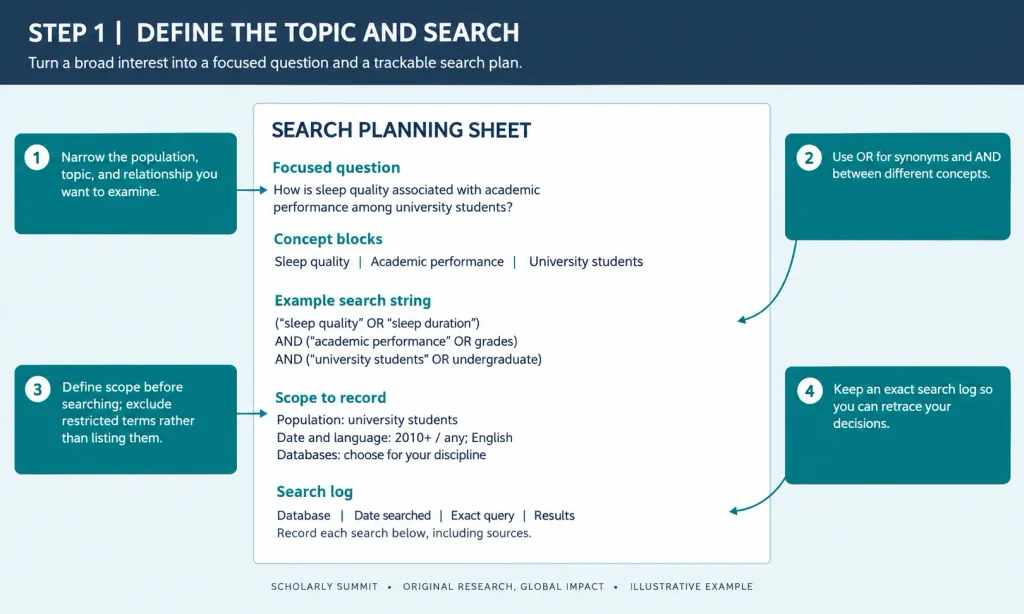
For example, a review on sleep and study performance might use: sleep, sleep deprivation, napping, academic performance, grades, university students.
Use these terms in databases such as Google Scholar, Scopus, Web of Science, JSTOR, or a subject database like PubMed or PsycINFO. Boolean operators sharpen the search, and they are the quickest way to learn how to start a literature review without drowning in irrelevant results: AND narrows results, OR widens them to include synonyms, and NOT excludes unwanted terms. Read abstracts to screen quickly, then check the bibliographies of useful papers for more leads. If the same authors or articles keep appearing, you have found the core of the field. Favor peer-reviewed articles, which are widely treated as the gold standard in research.
Step 2: Evaluate and Select Sources
You cannot read everything, so judge what earns a place. For each source, ask:
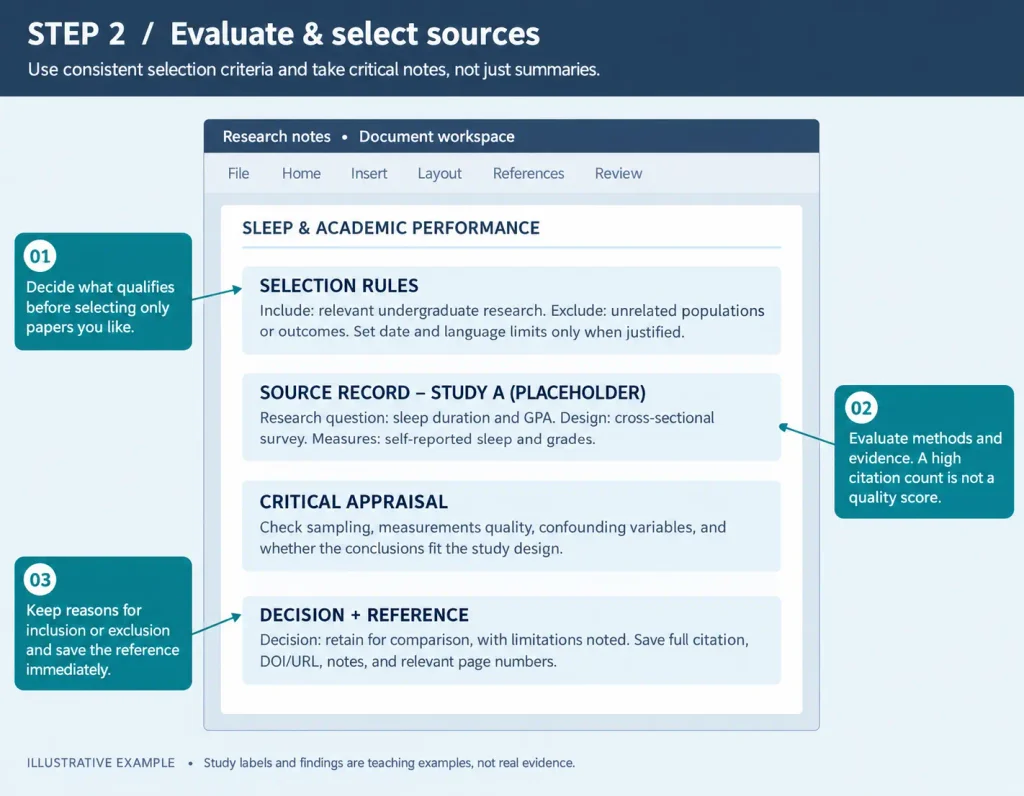
- What problem or question does the author address?
- Which theories, models, and methods are used?
- What are the results, and how credible are they?
- Does the work confirm, extend, or challenge established knowledge?
- What are its strengths and weaknesses?
High citation counts on Google Scholar suggest influence, but they do not prove quality, so always judge the study itself. Scope depends on your field: sciences usually prioritize recent work, while humanities often take a longer historical view. Take notes as you read and use reference software such as Zotero, Mendeley, or EndNote from day one. An annotated bibliography, with a short summary and critique for each source, saves hours later.
Step 3: Identify Themes, Debates, and Gaps
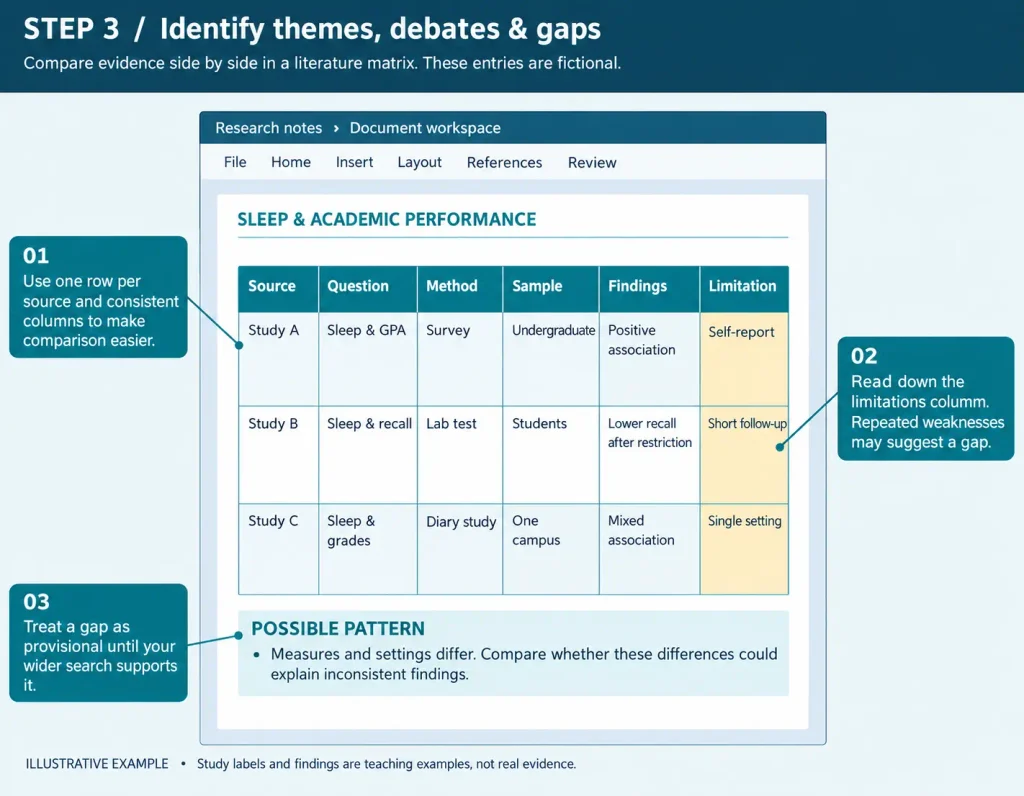
Now look across your notes. Note recurring themes, trends in method or theory, debates where sources disagree, pivotal studies that changed the field, and gaps. A simple way to see these is a literature matrix: a spreadsheet with one row per source and columns for question, method, sample, main finding, and limitation. Patterns jump out once the data sits side by side. You might notice, for instance, that most studies rely on self-reported sleep, and few use objective measures. That is a gap.
Step 4: Choose a Structure
Decide how the body of your review will be organized before you write. Whichever you pick, how to write a literature review that flows depends on a clear plan. Four common options exist, and you can combine them:
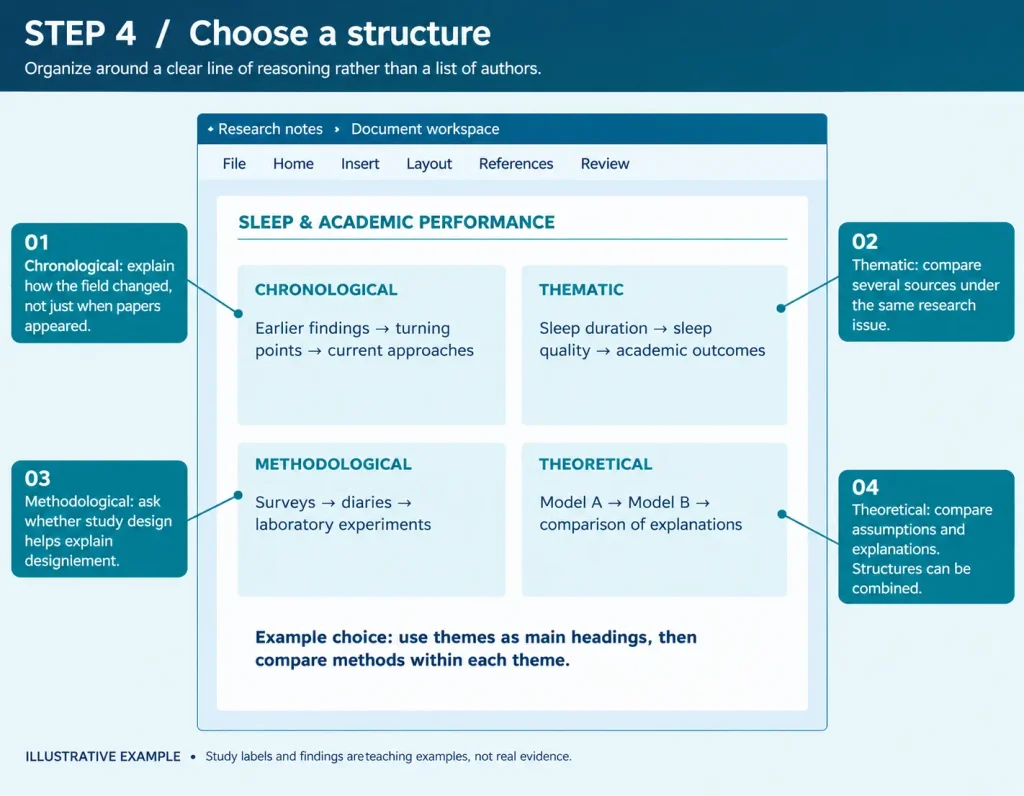
- Chronological: traces development over time. Avoid simply listing sources by date; explain turning points and why the field changed.
- Thematic: groups sources by recurring topics. This works well for most student papers.
- Methodological: compares qualitative and quantitative work, or empirical and theoretical approaches.
- Theoretical: discusses competing models and definitions to build a framework for your study.
Step 5: Write Your Review
Like any academic text, your review needs an introduction, a body, and a conclusion. Wondering how to start a literature review? Open by stating the topic, the scope (for example, the time period of your sources), and your purpose. In a thesis, restate your research problem and hint at the gap you will address.
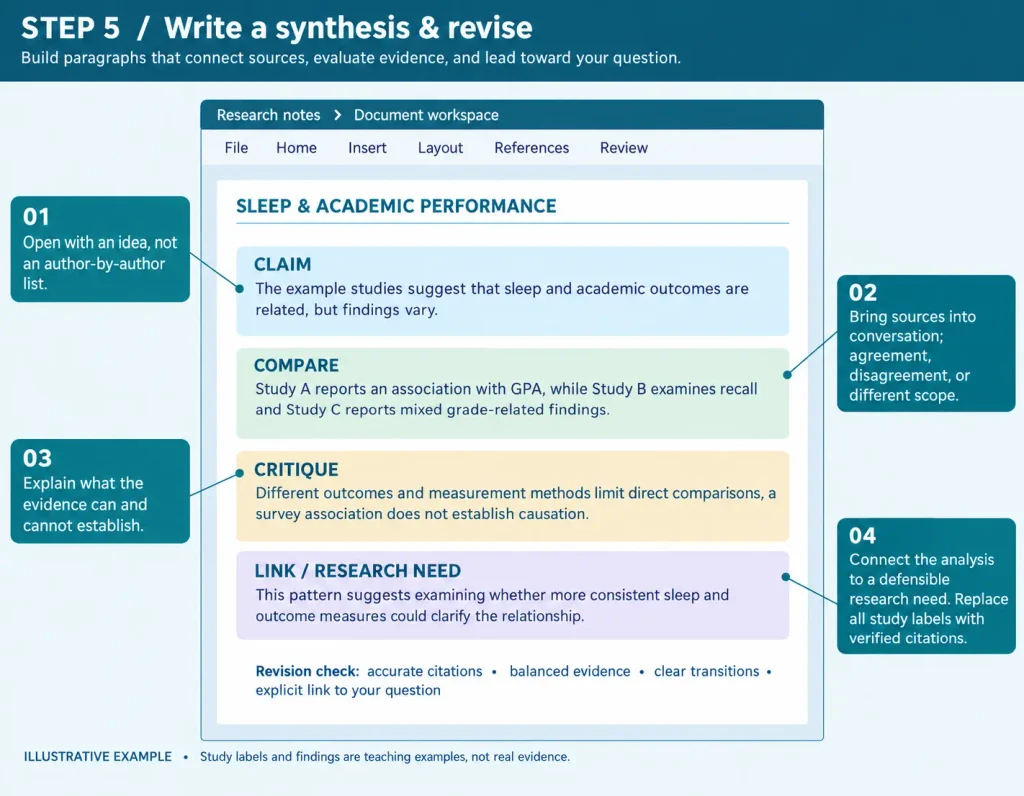
In the body, use a subheading for each theme, period, or approach. Build each paragraph with four moves: make a claim, compare what sources say, critique the evidence, and connect to the next idea. Here is a short illustration with citations left out:
Evidence that sleep loss harms memory is consistent but not uniform. Laboratory studies generally report weaker recall after restricted sleep, whereas classroom studies find smaller and less stable effects, possibly because grades reflect many factors beyond memory. Few studies, however, track sleep objectively across a full semester, which leaves open whether short-term laboratory effects persist in real academic settings.
That is what how to write a good literature review comes down to: synthesis. In your own paper, every claim carries a citation in the required style, such as APA, MLA, or Chicago. Write in a summary style: describe each study enough to explain its key finding, then move on. Readers can consult the originals for detail. Finish with a conclusion that summarizes what the literature shows and explains how your study fills the gap. Then revise at least once, and ask someone else to read it. Anyone learning how to make a literature review that reads smoothly should budget time for at least two full revisions. If the review sits inside a larger paper, merge it into your introduction or background section.
How Long Should a Literature Review Be?
There is no universal answer. A stand-alone review article is detailed and exhaustive, while a review inside a research paper needs only the significant studies, not every loosely related one. As a rough rule of thumb, it ranges from a few focused paragraphs in a journal article to an entire chapter in a thesis. Your assignment brief or journal guidelines decide. So when students ask how long should a literature review be, the honest answer is “as long as the brief allows and the argument needs.” If you cannot find a number, ask your supervisor, and remember that quality of synthesis matters more than length.
Why a Literature Review Matters?
Learning how to write a literature review pays off in four ways. It shows your reader you understand the field, whether you call the section a literature review or a review of related literature. It stops you from repeating work that already exists. It reveals gaps your study can fill.
Thesis, Journal Article, or Stand-Alone Review?
If you are working out how to write literature review for thesis chapters versus journal articles, note the difference in depth:
- Thesis or dissertation: usually a full chapter after the introduction, leading to your framework or methodology. Students who ask how to write literature review for thesis projects should plan this chapter early.
- Journal article: often condensed into the introduction, focused on studies your argument needs.
- Stand-alone review: the review is the research (a true review paper), so it needs a clear question, defined scope, and implications for future work.
6 Common Mistakes When You Learn How to Write a Literature Review
- Listing, not synthesizing. “Smith says… Jones says…” is a summary. Compare and connect instead.
- Over-quoting. Paraphrase and cite; keep direct quotes rare.
- Ignoring contradictory evidence. Disagreement is where the best analysis happens.
- Weak or outdated sources. Prefer credible, current scholarship unless history is your topic.
- No link to your question. Every theme should lead toward your own research.
- Sloppy citations. Track sources from the start to avoid plagiarism, a risk in any writing a literature review project.
Need extra literature review help? Your university library, writing center, or supervisor is the best first stop, and good literature review help is often free there. Our guide to research paper format also shows where this section belongs.
Using AI Tools for Your Review
AI can help you brainstorm keywords or explain unfamiliar concepts, but it can also fabricate references that look real. Open and read every source you cite, and never treat AI output as evidence. Good literature review writing depends on sources you have actually read. Because evaluation is the heart of how to write a literature review well, the critical thinking must be yours. Follow your institution’s disclosure rules, and avoid uploading unpublished or confidential material to public tools.
All in All
A literature review is a conversation among researchers, and you are the host who introduces everyone and shows where the discussion is headed. Search widely, read critically, organize by ideas, and write with your own voice. By doing this, the rest of your project gets easier, because how to make a literature review that works for readers is mostly about planning. Learning how to write a literature review takes practice, so be patient with your first draft.
Ready for the next section? Learn how to do a literature review, and your summary will work together with our guide on how to write a research paper abstract.
Frequently Asked Questions
Try the express method: write one paragraph per source, decide their order, combine them, add transitions, then add an introduction and a conclusion. Afterward, revise for synthesis.
In a dissertation, it normally follows the introduction. For a shorter paper, keep it focused on the studies your argument needs. In a shorter paper, it often sits within the introduction or background section.
An annotated bibliography describes sources one by one. A literature review organizes them into an argument about the state of knowledge.