
A research paper abstract is a standalone summary of 150 to 250 words that tells readers why you did the study, how you did it, what you found, and what it means. Write it last, in plain language, with no citations and no new information. That four-part formula is the whole secret, and this guide shows you how to write an abstract that editors, supervisors, and search engines actually notice, complete with a worked example you can adapt today.
What Is an Abstract in a Research Paper?
What is an abstract in a research paper? Think of it as the trailer, not the film, and not a vague teaser either. It is a miniature version of your work that must make sense on its own, yet it can never replace the paper itself. The abstract meaning in research is simply “a concise summary,” but its job is bigger than that.
Readers use it to decide whether your paper deserves their next twenty minutes. Databases and search engines use it, along with your title, to index your work. Reviewers often form a first impression from it before reading anything else. That is why abstract writing deserves real attention, even though it is the shortest part of your manuscript. A well-written abstract in research gets found, read, and cited more often, while a vague one gets skipped. A well-built research abstract also helps you, because writing it forces you to name your single most important contribution.
What Goes Into a Strong Abstract?
Nearly every good abstract of a research paper makes the same four moves, whether you work in the sciences, the social sciences, or the humanities.
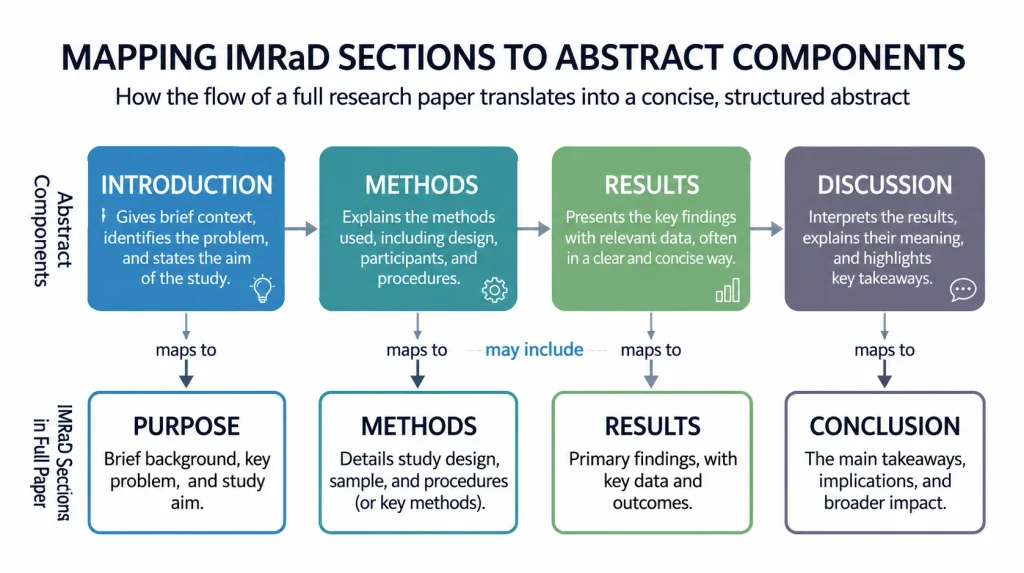
- Purpose: the problem or question, with a touch of context.
- Methods: what you did, in one or two sentences.
- Results: your most important findings, with key numbers if you have them.
- Conclusion: what the findings mean, one major limitation, and where research goes next.
Disciplines differ in emphasis, and even the abstract meaning in research shifts slightly between fields, so study a few abstract examples from two or three recent articles in your target journal before drafting. Humanities abstracts bend this pattern. They usually state the topic, the central argument, the evidence examined, and the significance. Structured abstracts, common in medicine, label each move (Objective, Methods, Results, Conclusions). Whatever the format, an abstract in research mirrors your paper, so an IMRaD paper (Introduction, Methods, Results, and Discussion) produces an IMRaD-shaped summary.
How to Write an Abstract for a Research Paper? 6 Essential Steps
Follow these six steps in order. Each one takes minutes, not hours, once your paper is finished. If you have ever asked how to write an abstract for a research paper without sounding vague, this sequence is your answer.
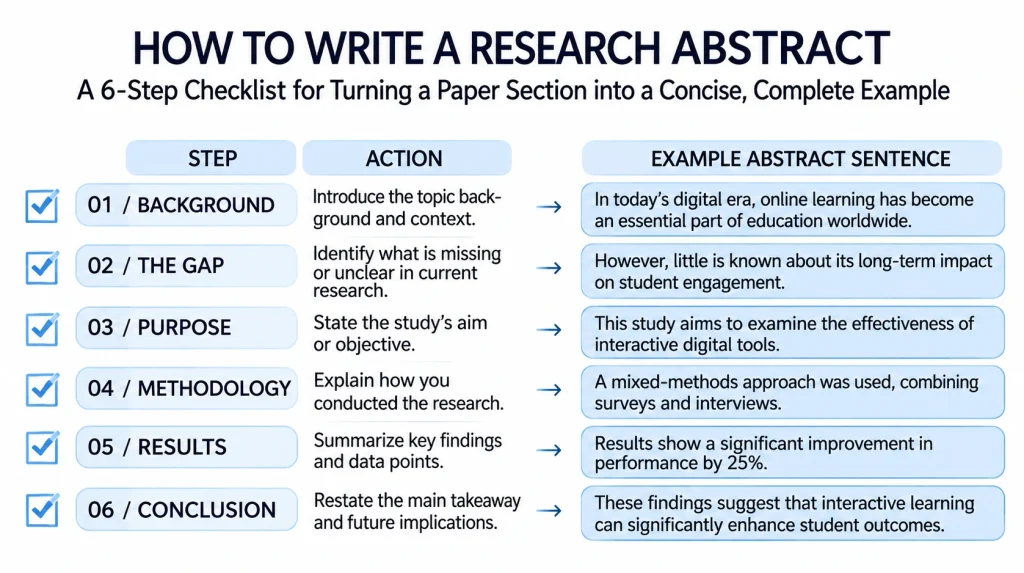
Step 1: Finish the Paper First
Your abstract summarizes work that already exists. Drafting it early invites promises the paper never keeps, which is the most common trap in writing an abstract. Write it after your final draft and before your last proofread.
Step 2: Open With the Problem and Your Aim
Wondering how to start an abstract? Begin with the gap or question, then state your aim using an active verb such as investigate, test, analyze, or evaluate. One sentence of context is enough. Define a specialist term only if the average academic reader would not know it, because one word can mean different things across fields. Use the present or past tense, never the future, because the research is complete. If you are still unsure how to start an abstract, draft one rough sentence for each of the four moves and join them later.
Step 3: Describe Your Methods Briefly
Use one or two past-tense sentences covering design, sample, data source, and analysis. This is the part of abstract writing where precision matters most. Do not defend the method here; the body of the paper does that.
Step 4: Report the Key Results
Give your most important findings, not all of them. Numbers beat adjectives: “recall improved by 12 percent” says more than “recall improved considerably.”
Step 5: State the Conclusion and Why It Matters
Answer the question you opened with. Mention one major limitation if it affects credibility, and add an implication or a direction for future research if space allows.
Step 6: Cut, Tighten, and Add Keywords
Trim until each sentence carries one idea. Prefer active voice, delete filler, and define any abbreviation you cannot avoid. If the journal asks for keywords, choose terms a researcher would genuinely search for, because they help indexing.
Research Paper Abstract Example
4 Types of Abstracts and Their Typical Lengths
A research paper abstract changes shape depending on where you submit it. Check the guidelines before drafting; the word limit of your journal or university always wins. Whenever you are writing an abstract for a new venue, confirm the type first.
| Type | Typical length | What it includes | Common in |
| Informative | 150–250 words | Purpose, methods, results, conclusion | Journal articles, term papers |
| Structured | Journal-set limit | Same content under labelled headings (Objective, Methods, Results, Conclusions) | Medicine and health sciences |
| Descriptive | Often under 100 words | Scope and approach, usually without results | Humanities, some conference submissions |
| Thesis or dissertation | 200–300 words | Summary of the entire project, including limitations | Graduate theses |
Abstract Formatting Rules: APA, MLA, IEEE, and Journals
1. APA
In APA 7th edition, a professional paper places the abstract on its own page after the title page. It is headed “Abstract,” written as one unindented paragraph, and usually kept to 250 words or fewer. Keywords follow on a new indented line that begins with an italic “Keywords:” label. Student papers include an abstract only if the instructor asks for one.
2. MLA
MLA does not require an abstract for a standard paper. Add one only when your instructor or publisher requests it.
3. IEEE
IEEE abstracts are a single paragraph of roughly 150 to 250 words. Avoid citations, equations, and undefined abbreviations, and follow the abstract with index terms.
4. Theses and Journals
The abstract of a research paper for a thesis or dissertation sits on a separate page after the title page and acknowledgements, before the table of contents. For journals, the author guidelines override every general rule, including headings and word counts. For the wider layout of your manuscript, see our guide to research paper format.
7 Common Research Paper Abstract Mistakes (and Fixes)
- Writing it first. Draft it after the paper so it reflects what you actually found.
- Too much background. Context deserves one sentence, not a paragraph.
- Hiding the results. A line like “results are discussed” tells readers nothing. State the finding.
- Adding claims the paper does not support. Every statement must be traceable to your paper.
- Citing sources. The abstract describes your work. Cite others only if your study responds directly to one specific study or theorist.
- Copy-pasting sentences from the paper. An abstract is a self-contained text, so rewrite rather than excerpt.
- Stuffing keywords. Use natural, precise terms. Stuffing makes the abstract harder to read and does not help indexing.
Using AI Tools? Verify It and Declare It
Many publishers and universities now require disclosure of generative AI use, and none accept an AI tool as an author. If you use one to tighten a draft, treat it like a language editor: you remain responsible for every claim. Compare the final research paper abstract line by line against your paper, because automated summaries can invent numbers or conclusions you never reported. Avoid pasting unpublished data into public tools, and state your AI use wherever the journal asks for it, often in the acknowledgements or a dedicated declaration.
Pre-Submission Checklist
- It makes sense without the paper and cites no sources.
- It covers purpose, methods, results, and conclusion.
- Tense is consistent, and nothing refers to the future.
- Numbers match those in the paper exactly.
- It meets the word limit and format your journal or course requires.
- Keywords are included if requested.
A strong research paper abstract also pairs well with a solid background section, so read our guide on the literature review guide next.
Conclusion
A good abstract is not magic; it is four moves done cleanly. Finish the paper, state your purpose, methods, results, and meaning, then trim until nothing is wasted. Read it aloud once. If it could stand beside any example of abstract in research you admire, submit it. If a stranger could understand your contribution in thirty seconds, you are ready to submit. Mastering the research paper abstract is a small skill with a big payoff, and knowing how to write an abstract well will serve you in every course and journal submission. Need help with citations next? Explore our citation style guide.
Frequently Asked Questions
Most are 150 to 250 words, and thesis abstracts often run 200 to 300. Your journal or university limit takes priority.
Generally no. The abstract should focus on your original work and stand on its own.
Last, after the full draft, you are summarizing what exists.
What is an abstract? Put simply, it is a complete summary of the whole paper, including results. What is an abstract versus an introduction comes down to results. The introduction sets up the problem and your aim, and it does not summarize your findings.