
Research methodology examples show how a researcher moves from a research question to a suitable approach, participants or sources, data-collection procedure, analysis strategy, and ethical safeguards. A strong research methodology explains not only what you did, but why those decisions were appropriate for your research questions and context.
This guide explains research methodology through realistic, adaptable examples for qualitative, quantitative, and mixed-methods studies. The examples are hypothetical teaching scenarios, not reports of actual published studies; they are intended to help you adapt the logic to your own thesis, dissertation, or research paper.
What Is Research Methodology?
Research methodology is the overall strategy and rationale for answering a research problem. It explains the type of evidence needed, the way participants or materials will be selected, the procedures for collecting data, the analytical techniques, and the standards used to judge quality.
The research methodology meaning is broader than a list of techniques. It includes the reasoning behind those techniques: why a survey suits a measurable comparison, why interviews suit an under-explored experience, or why a mixed-methods design can explain both patterns and reasons behind them.
A clear methodology in research allows readers to assess whether the study is credible, whether the conclusions are supported, and whether another researcher could repeat or extend the work. It also demonstrates that ethical obligations were considered throughout the project.
Methodology, Methods, Design, and Approach
These terms are related but not interchangeable. Research methodology is the overarching plan and justification. Research methods are the specific tools used to gather and analyse data. Research design is the structural plan that connects questions, data, and analysis. Research approach refers to the broader logic of inquiry, such as inductive, deductive, or abductive reasoning.
| Term | What it answers | Research method example |
| Research methodology | What is the overall strategy and why? | A mixed-methods study to measure access barriers and explain students’ experiences |
| Research method | What tool or procedure will be used? | An online survey, semi-structured interview, experiment, or document analysis |
| Research design | How are the parts of the study organized? | Cross-sectional survey, randomised experiment, case study, or longitudinal design |
| Research approach | What logic guides the inquiry? | Deductive testing of a hypothesis or inductive development of themes |
For example, a quantitative research method may involve a questionnaire measuring study hours and grades. The methodology explains why those variables were selected, how the sample was chosen, how the questionnaire was validated, and which statistical analysis will test the relationship.
Qualitative, Quantitative, and Mixed Methods
The three main methodology types differ in the kind of evidence they prioritise. Quantitative research uses numerical measurement to describe patterns, test relationships, or compare groups. Qualitative research uses words, observations, and documents to explore meanings, processes, and experiences. Mixed-methods research combines both forms of evidence when neither alone can answer the question adequately.
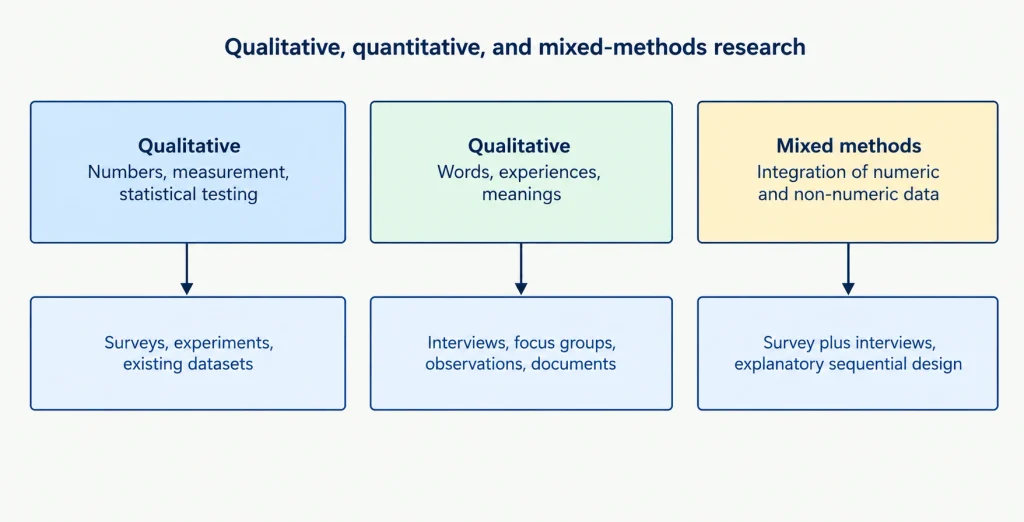
A quantitative methodology example could examine whether attendance at academic-skills workshops is associated with higher first-year grade-point averages. A qualitative methodology example could ask students to describe why they do or do not attend such workshops. A mixed-methods example could first survey attendance and outcomes, then interview a smaller group to explain unexpected patterns.
| Dimension | Quantitative | Qualitative | Mixed methods |
| Main evidence | Numbers and measurements. | Words, actions, images, documents. | Numeric and non-numeric data. |
| Typical purpose | Measure, compare, and test. | Explore, interpret, understand. | Explain, expand, or validate. |
| Common methods | Surveys, experiments, secondary datasets. | Interviews, focus groups, and observation. | Sequential or concurrent combination. |
| Typical analysis | Descriptive statistics, correlation, and regression. | Coding, thematic, or content analysis. | Integration through merging or connection. |
| Quality emphasis | Reliability, validity, generalisability. | Credibility, trustworthiness, reflexivity. | Integration quality and transparency. |
Choosing an Appropriate Research Design
Research designs describe how a study is organized. They should follow from the research question, not from personal preference or convenience. Experimental, descriptive, correlational, exploratory, and explanatory designs answer different kinds of questions.
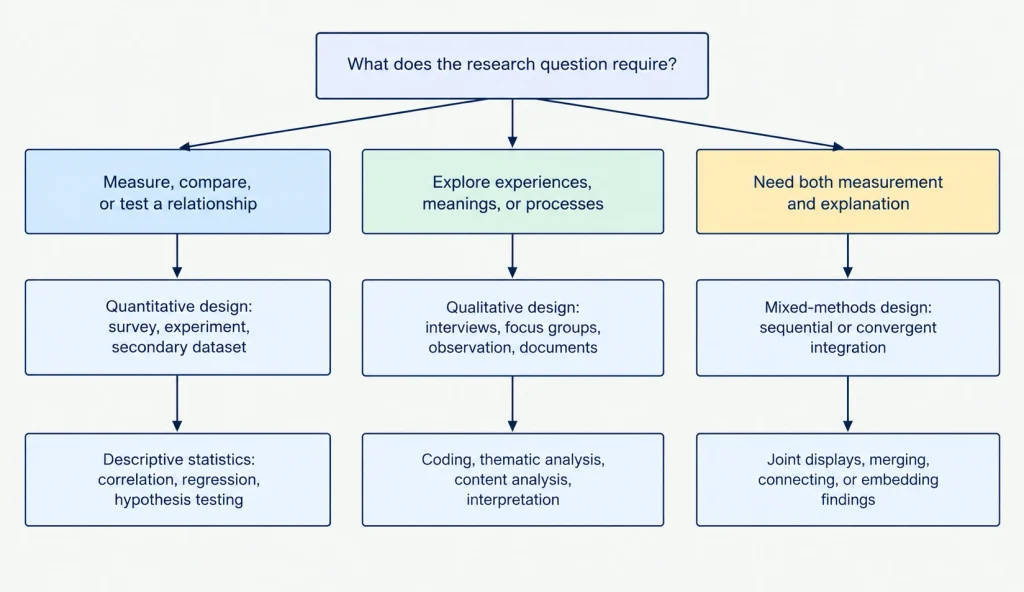
An experimental design manipulates one or more conditions and measures the effect on an outcome. A descriptive design records characteristics or patterns without testing causal claims. A correlational design examines associations among variables but cannot by itself establish cause and effect. Exploratory research investigates a poorly understood issue, while explanatory research seeks to account for why a pattern occurs.
A common error is to use causal language in a correlational study. If a survey finds that students who sleep more report better concentration, the study can describe an association, but it cannot prove that sleep causes concentration without addressing alternative explanations and, where appropriate, using an experimental or longitudinal design.
Primary, Secondary, and Review-Based Research
Primary research collects new data directly from participants, observations, experiments, or original documents. Secondary research analyses data or materials produced by others, such as government statistics, organisational records, archival collections, or previously published studies.
A systematic review is a structured secondary method that identifies, appraises, and synthesises research according to predefined criteria. It differs from a narrative literature review because it documents the search strategy, inclusion and exclusion criteria, appraisal process, and method of synthesis.
Document or archival analysis can be primary or secondary depending on the material and research role. Analyzing historical university policy documents for a new historical argument may function as primary source analysis; reanalyzing an existing national dataset is secondary data analysis.
7 Examples of Common Research Methods
The following research methods examples illustrate how the same broad method can serve different questions. Each example is hypothetical and should be adapted to disciplinary conventions, available resources, and ethical requirements.
| Method | Hypothetical example | Why it fits |
| Survey | A business researcher surveys 250 hypothetical employees about remote-work satisfaction and productivity. | Useful for measuring attitudes and associations across a larger sample |
| Interview | An education researcher interviews 12 hypothetical teachers about classroom AI-use policies. | Appropriate for exploring experiences and reasoning in depth |
| Focus group | A healthcare researcher conducts three focus groups with hypothetical caregivers about discharge information. | Useful for revealing shared views, disagreements, and group interaction |
| Observation | A psychology researcher observes hypothetical classroom interactions using a structured observation schedule. | Suitable for studying behaviour in its natural setting |
| Experiment | A researcher randomly assigns hypothetical participants to two feedback conditions and measures task accuracy. | Appropriate when testing a causal effect under controlled conditions |
| Case study | A management researcher examines one hypothetical organisation’s response to a supply-chain disruption. | Useful for an in-depth, context-sensitive examination of a bounded case |
| Secondary-data analysis | A public-health researcher analyses an existing anonymised national health survey. | Efficient for examining population-level patterns when suitable data exist |
An Integrated Methodology Example
The following integrated example shows how a research question, design, sampling strategy, data collection, and analysis fit together. It is a hypothetical education study, not a report of a real project.
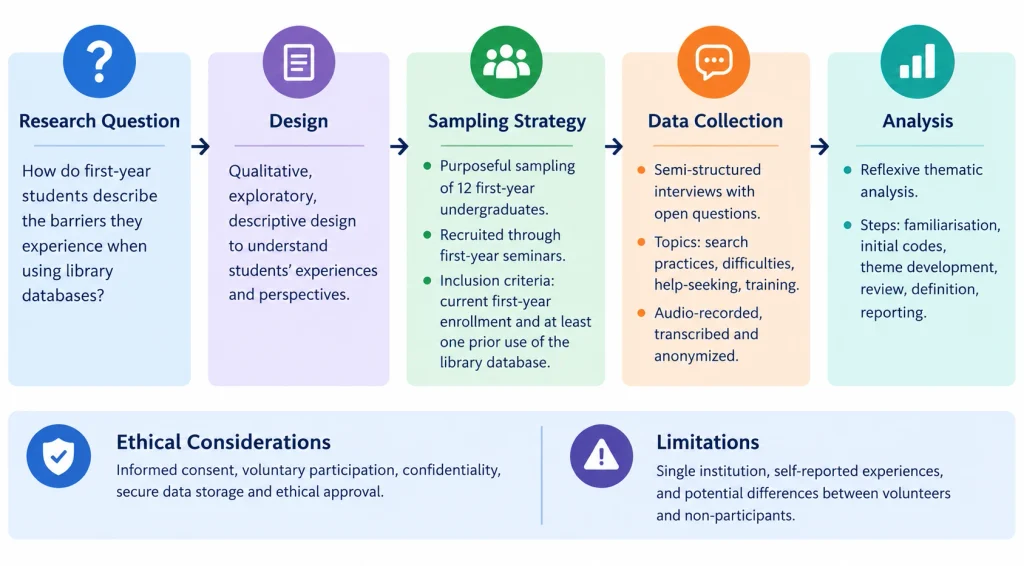
Research problem: first-year students may struggle to use academic library databases, but staff may not understand which barriers matter most. Research question: how do first-year students describe the barriers they experience when using library databases?
A qualitative exploratory descriptive design is appropriate because the purpose is to understand students’ experiences rather than measure the frequency of predefined barriers. The target population is first-year undergraduate students at one university. A purposeful sample of 12 hypothetical students could be recruited through first-year seminars, with inclusion criteria requiring current first-year enrolment and recent use of library databases. The number 12 is illustrative, not a universal requirement; qualitative sample size depends on the study’s scope, depth of data, and point of information sufficiency.
Data collection could use semi-structured interviews with open questions about database searches, help-seeking, confidence, and previous instruction. Interviews would be audio-recorded with consent, transcribed, and anonymised. Reflexive thematic analysis could begin with familiarisation, initial coding, theme development, review, definition, and reporting. This methodology fits because it generates detailed accounts of barriers that a closed-ended survey might not anticipate.
Ethical considerations include informed consent, voluntary participation, confidentiality, secure storage of recordings, and the right to withdraw. Limitations could include reliance on one institution, self-reported experiences, and the possibility that volunteers differ from students who do not use library databases.
Parts of a Methodology Section
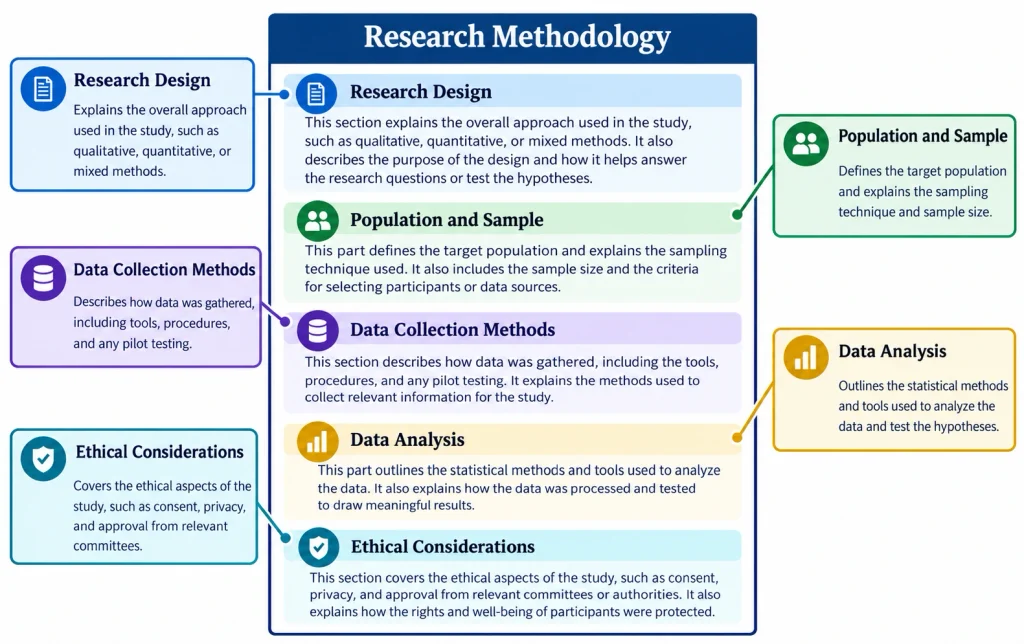
The parts of methodology vary by discipline and document type, but a strong methodology in a research paper or thesis usually addresses the same core decisions. It should be detailed enough for evaluation while avoiding unnecessary technical background.
Sampling, Instruments, and Analysis
Sampling determines who or what provides evidence. Probability sampling, such as simple random or stratified sampling, supports statistical generalisation when the sampling frame is appropriate. Non-probability sampling, such as purposeful, convenience, or snowball sampling, is often suitable for qualitative exploration but requires transparent discussion of its limits.
Inclusion and exclusion criteria should be operational rather than vague. Instead of writing “students with experience,” specify “undergraduate students enrolled in the 2026 academic year who had used the university library database at least once.” Sample size should be justified in relation to the analysis plan, not presented as a universal rule.
Quantitative analysis may include descriptive statistics to summarise data, correlation to examine association, regression to assess relationships while accounting for other variables, or hypothesis testing where the design and data meet the relevant assumptions. Qualitative analysis may use thematic analysis to identify patterns of meaning, content analysis to classify recurring material, or discourse analysis to examine language in social context.
In mixed-methods research, integration is essential. A convergent design might merge survey scores and interview themes in a joint display. An explanatory sequential design might use qualitative interviews to help explain quantitative results. Simply placing two datasets in separate chapters without integration does not constitute a genuine mixed-methods analysis.
Quality, Bias, and Transparency
Reliability concerns consistency: would the instrument or procedure produce similar results under comparable conditions? Validity concerns accuracy: does the instrument or design actually measure the intended concept? In qualitative research, credibility, dependability, confirmability, and transferability are often more appropriate quality criteria than statistical reliability alone.
Bias can enter through participant selection, question wording, observer expectations, missing data, or selective reporting. Researchers reduce these risks through clear protocols, pilot testing, transparent exclusion rules, reflexive memos, and pre-specified analysis procedures where appropriate.
Reproducibility and transparency improve when researchers document data sources, instruments, coding decisions, statistical assumptions, software versions, and deviations from the original plan. A methodology should enable informed evaluation, even where full replication is impossible because of contextual or ethical constraints.
Research Ethics
Ethical research protects participants, data, and the integrity of the academic record. Core obligations include informed consent, voluntary participation, confidentiality or anonymity where promised, secure data storage, minimization of harm, and appropriate ethics approval from an institutional review board or ethics committee.
Ethical requirements vary by country, institution, discipline, and participant group. Research involving children, patients, vulnerable groups, sensitive personal data, or deception normally requires additional safeguards. Researchers should describe these safeguards in the methodology rather than treating ethics as an afterthought.
Sample Methodology Passage
The following sample passage is hypothetical and is provided as a model for structure and transparency. It should be adapted to the actual study, institution, and disciplinary conventions.
This hypothetical study used a qualitative exploratory descriptive design to examine first-year students’ experiences of using academic library databases. Twelve first-year undergraduate students were recruited through purposeful sampling from first-year seminar classes. Inclusion criteria required current first-year enrolment and at least one prior use of the university library database. Semi-structured interviews explored search practices, difficulties, help-seeking, and training experiences. Interviews were audio-recorded with informed consent, transcribed, anonymised, and analysed using reflexive thematic analysis. Coding proceeded from familiarisation and initial codes to candidate themes, review, definition, and reporting. Credibility was supported through participant checking of preliminary themes, while reflexivity was maintained through analytic memos. Participation was voluntary, data were stored securely, and ethical approval was obtained from the university ethics committee. The single-site sample limits transferability, and findings represent participants’ reported experiences rather than directly observed search behaviour.
Checklist for a Strong Methodology Section
1. State the research aim and questions before explaining procedures.
2. Justify the research approach and design in relation to the questions.
3. Describe the population, sampling strategy, and inclusion and exclusion criteria.
4. Explain how the sample size or number of sources was determined.
5. Describe each instrument, dataset, or archival source and its role.
6. Explain the data-collection procedure, timing, setting, and materials.
7. Specify the analysis method, software where relevant, and integration procedure.
8. Address reliability, validity, credibility, bias, and limitations.
9. Describe informed consent, confidentiality, data protection, and ethics approval.
10. Provide enough detail for an informed reader to evaluate the study.
6 Common Methodology Mistakes
| Common mistake | Corrected approach |
| Describing methods without justification | Explain why the method answers the research question. |
| Using causal language in correlational research | Describe associations unless the design supports causal inference. |
| Reporting a sample size without rationale | Link the sample to the analysis plan and study scope. |
| Treating qualitative and quantitative quality identically | Use criteria appropriate to the evidence and tradition. |
| Separating mixed-methods data without integration | Show how the datasets are connected, merged, or sequenced. |
| Mentioning ethics only in a final sentence | Integrate consent, confidentiality, data protection, and approval into the procedure. |
Wrapping Up
Strong research methodology examples do more than label a study as qualitative, quantitative, or mixed methods. They show a coherent chain from research question to design, participants or sources, data collection, analysis, quality safeguards, ethics, and limitations.
Before writing, ask whether each methodological decision helps answer the research question. If it does, explain it clearly. If it does not, revise the design or the question. That alignment is the practical foundation of credible methods of research and thesis writing.
Frequently Asked Questions
Research methodology explains the overall strategy for answering a research question, including the research design, data collection, analysis, and ethical considerations.
The three main types are qualitative, quantitative, and mixed-methods research. Each approach serves different purposes, from exploring experiences to measuring variables and combining both forms of evidence.
Research methodology explains why a particular research strategy is appropriate, while research methods are the specific techniques used to collect and analyze data, such as surveys or interviews.
A researcher studying students’ library database experiences could interview 12 students, use purposeful sampling, and apply thematic analysis to identify common challenges.
Four commonly used research methods are surveys, interviews, experiments, and observation. The best method depends on the research question and the type of evidence required.