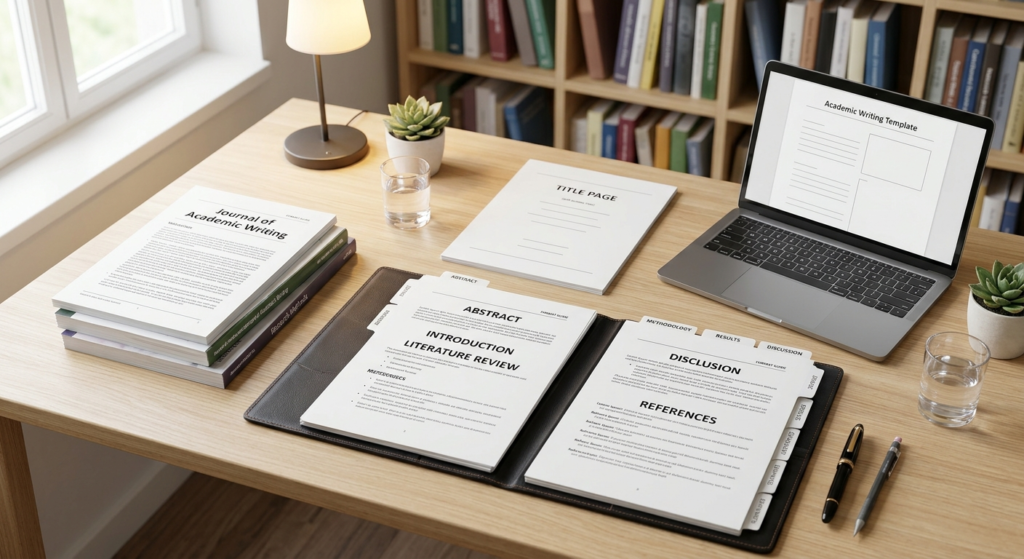
The standard research paper format is a seven-part structure: title, abstract, introduction, literature review, methodology, results, and a discussion that closes with your conclusion. It is the agreed structure, layout, and citation style that tells readers where every part of your argument lives, and most instructors and journals expect it in 12-point font, double-spaced, with one-inch margins. Learn that order and the blank page stops being scary, because every paragraph you write already has a home.
Know more about research paper formatting techniques and process in this video below:
What is Research Paper Format (And Why Markers Care)
Students often ask what is the format of research paper assignments, and the honest answer is a set of conventions, not a single rule. Think of the format of a research paper as a map. Headings, margins, fonts, and citations are landmarks that let your reader find your question, evidence, and answer without hunting. Good academic paper format also protects you. A marker working through forty submissions rewards the paper that is easy to follow, and a consistent paper format is the cheapest way to look prepared.
Research format works in three layers. Structure is the order of sections. Layout covers page size, margins, spacing, and fonts. Your research style is the citation system your department names, usually APA, MLA, or IEEE. Anyone asking what is format in research is usually fine on one layer and losing marks on another.
Journals add a fourth layer. Editors often return manuscripts before peer review when the scientific paper format ignores the author guidelines, however strong the science is. Read the guidelines first, because the format for research paper submissions that a journal lists overrides every general guide, including this one. Proper format is a courtesy to your reader, and the proper format of research paper work earns trust before anyone reaches your first argument.
The Standard 7-Part Research Paper Structure
Every part answers one question. Together they move from broad (why this matters) to narrow (what you did) and back out to broad (what it means), a shape often called the hourglass. List these seven headings in your research paper outline before you write a sentence. Peer reviewers usually skim the title, abstract, and figures before they read the body, so polish those first.
| Section | Question it answers | Typical length |
| Title | What is this about? | 10 to 15 words |
| Abstract | What is the whole paper in brief? | 150 to 250 words |
| Introduction | Why does it matter? | About 10% |
| Literature Review | What is already known? | 15 to 20% |
| Methodology | How did you do it? | 10 to 15% |
| Results | What did the evidence show? | About 20% |
| Discussion & Conclusion | What does it mean? | 20 to 25% |
IMRaD vs. Thematic Structure and Which One You Need
IMRaD stands for Introduction, Methods, Results, and Discussion. It is the default research article format in medicine, psychology, engineering, and the natural sciences because it mirrors how a study unfolds, and it anchors the scientific paper format taught in most labs. The literature review usually folds into the introduction, and the methodology shortens to “Methods.” If your paper reports data you collected or analyzed, use IMRaD.
Thematic structure organizes the body by ideas instead of procedure. A history or literature paper might give each theme or debate its own section, then close with a synthesis. Many humanities instructors expect this research essay format, and it suits literature-based reviews in the social sciences. The format of research differs by discipline, so match yours.
Modern journals have stretched both. Expect structured abstracts, data availability statements, limitation subsections, and ethics and funding declarations. Many now require an AI-use declaration too: a short statement naming any generative tool you used and what for. Place it where the guidelines say, often just before the reference list. Tools are never listed as authors, and you stay responsible for every sentence.
Still unsure? If you collected data, choose IMRaD. If you built an argument from sources, go thematic. Either way, the research paper pattern holds: setup, evidence, and meaning. Ask your instructor for a past paper that earned top marks, which is the most reliable format example you will find. Choosing the format for research that fits your question saves rewrites later. A common student pitfall is forcing IMRaD onto a purely theoretical paper, which leaves an empty Methods section and a confused reader.
Step-by-Step Blueprint to Formatting Each Section
1. Set Up the Page First
Fix the layout before you type. Most college rubrics expect US Letter or A4 paper, one-inch margins on every side (the usual margin for research paper answer), 12-point Times New Roman or another font your style guide approves, double spacing, and left-aligned text. That research margin format and research page layout repeat on every page and together shape your research paper layout. Page size follows your country, while the size of research paper in pages or words comes from your assignment brief. Build headings with Word’s built-in styles so spacing never drifts, and start from a research paper template Word file if your library offers one. Do this once, and you know how to format a research paper for every course. Keep a one-page format paper checklist beside you.
2. Build the Title Page and Header
APA student papers use a title page: a bold title, then your name, department and institution, course, instructor, and date. MLA skips the cover page and puts your name, instructor, course, and date at the top of page one, above a centered title. Whichever research front page format applies, your research paper header carries a page number in the top right corner, and MLA adds your last name before it. Journal submissions go further, and the research format front page adds affiliations, a corresponding author email, and keywords. Thesis writers add an abstract page, dedication, and table of contents ahead of chapter one, so check your thesis paper format guide early. Keep the title to 10 to 15 specific words: “Effects of Sleep Loss on Memory in Undergraduates” beats “A Study of Sleep.” Before drafting, open a format research paper example in your style and copy its skeleton.
3. Write the Abstract Last
The abstract is one paragraph of 150 to 250 words stating your purpose, method, main findings, and conclusion, with no citations and no new claims. Write it after everything else, when you know what the paper says. The short version of how to write an abstract is one or two sentences per section, plus three to six keywords if the journal asks.
4. Shape the Introduction and Literature Review
Open with the broad problem, narrow to the gap, and finish with your research question or thesis statement. If you struggle with how to write an introduction, draft it after the body, once your argument is settled. The literature review section groups sources by theme or debate, never source by source, and ends by naming the gap your study fills.
5. Report Methods, Results, and Discussion Cleanly
Write the methodology in past tense with enough detail that another researcher could repeat your work: participants or sources, tools, procedure, and analysis. Results report what the evidence shows and nothing more. Number every table and figure, caption it, and refer to it in the text. The discussion interprets those results, compares them with the literature, admits limitations, and ends with a short conclusion that adds no new evidence. Keep your research writing format formal: past tense for what you did, present tense for what findings mean.
6. Finish with Citations and References
Pick one style and stay with it. APA citation style uses author-date in-text citations and a reference list on its own page with hanging indents. MLA format uses author-page citations and a Works Cited page. IEEE numbers sources in brackets in order of appearance. Whatever the style, consistent academic paper format means every entry follows one pattern. Every source cited in the text must appear in the list, and the reverse. In APA, appendices follow the references. Before submitting a manuscript, run a last pass against the author checklist: word count, figure resolution, reference style, required declarations, and anonymized files if the journal uses double-blind review.
Research Paper Format Example
Skip to PDF content5 Common Formatting Mistakes That Drop Your Grade (and How to Fix Them)
1. Mixing Citation Styles
Half-APA, half-MLA references are the quickest way to look careless. Choose the style named in your brief, then check a dozen entries against its manual before submitting. Reference managers help, but they still need a human check.
2. Writing the Abstract Before the Paper
It promises results the paper never delivers. Rewrite it after your final edit and match every claim to a section.
3. Turning the Literature Review into a List
Summarizing one source after another reads like an annotated bibliography. Group studies by theme, compare them, and end on the gap.
4. Mixing Results with Interpretation
Results report, and the discussion explains. Move every “this suggests” to the discussion, and keep new data out of your conclusion.
5. Assuming One Format Fits Everything
A high school research paper format is lighter than a college research paper format, and a thesis paper format adds front matter such as acknowledgements and a table of contents. Check the brief every time, because college paper format rules change by department and the proper format for research paper work depends on level.
Ending Note
Format feels like a chore until you see what it buys you: a reader who finds your point on the first pass. Save a template for research paper assignments with your styles, margins, and seven headings set, then reuse it. Open it tonight, start with the section you know best, and let the structure carry you. Format once, write freely.
Frequently Asked Questions
Title, abstract, introduction, literature review, methodology, results, and discussion with a conclusion. Use 12-point font, double spacing, and one-inch margins.
Set one-inch margins, 12-point Times New Roman, and double spacing. Use Word’s Heading styles, then save the file as a reusable template.
A bold title, your name, institution, course, instructor, and due date, with a page number at top right. MLA uses a heading block instead.
One inch on all four sides is the default in APA, MLA, and most college rubrics. Follow your brief if it says otherwise.
Clean and consistent: a clear title, labelled sections, double-spaced text, numbered figures, and a matching reference list. Skip decorative fonts and colors.
Yes. University writing centers and the official APA and MLA sites publish annotated sample papers. A graded paper from your department is still a better research paper example format.
Page size is US Letter or A4. Length comes from your brief, and journals set their own word limits.
APA student papers show a page number only. MLA adds your last name before it, and professional APA papers add a short running head.
Use whichever your instructor names, and follow its rules for title page, headings, citations, and references. Never mix the two.
Many journals and universities now require one. Name the tool, state what you used it for, and place it where the guidelines say.