
Research publication ethics covers the responsibilities researchers carry from study design through to publication and beyond. It is not just about avoiding plagiarism, it shapes how research is planned, conducted, reported, reviewed, and corrected.
Understanding what is publication ethics in research helps authors protect participants, colleagues, journals, and the integrity of the scholarly record itself.
What Is Research Publication Ethics?
Publication ethics refers to the standards governing how research is conducted, reported, and disseminated. Research ethics focuses on protecting participants and ensuring studies are conducted responsibly. Research integrity and publication ethics together cover honesty, transparency, and accountability across the whole research lifecycle.
Ethics in research and publication is a shared responsibility. Authors, co-authors, editors, reviewers, institutions, and publishers all play a role. Research and publication ethics fail when any one of these groups neglects its duties.
Research ethics examples include obtaining informed consent, protecting confidentiality, minimizing risk, and ensuring fair authorship. These principles apply across disciplines, though specific requirements vary by field, institution, and jurisdiction.
4 Ethical Principles Every Researcher Should Follow
Research ethics and publication ethics work together to ensure that studies are conducted responsibly and findings are reported honestly. Researchers should follow these fundamental principles throughout the research and publication process.
1. Research Ethics vs Publication Ethics
Research ethics governs the responsible design and conduct of studies, while publication ethics focuses on how findings are written, submitted, reviewed, and published. Both are essential to maintaining trustworthy academic research.
2. Informed Consent and Participant Protection
Researchers must obtain voluntary informed consent, explain potential risks, protect participants’ privacy, and minimize possible harm. Participants should understand their rights before agreeing to take part in a study.
3. Research Ethics Approval and Ethical Oversight
Researchers should obtain the required institutional or ethics committee approval before conducting research involving humans or animals. They must also follow approved protocols and report any significant changes to the relevant ethics committee.
4. Honesty, Transparency, and Accountability
Researchers must report findings accurately, maintain reliable research records, disclose relevant conflicts of interest, and take responsibility for their work. These principles help prevent misconduct and strengthen research integrity.
6 Common Ethical Issues in Research and Publication
The most common ethical issues in research and publication include plagiarism, fabrication, falsification, duplicate submission, and duplicate publication.
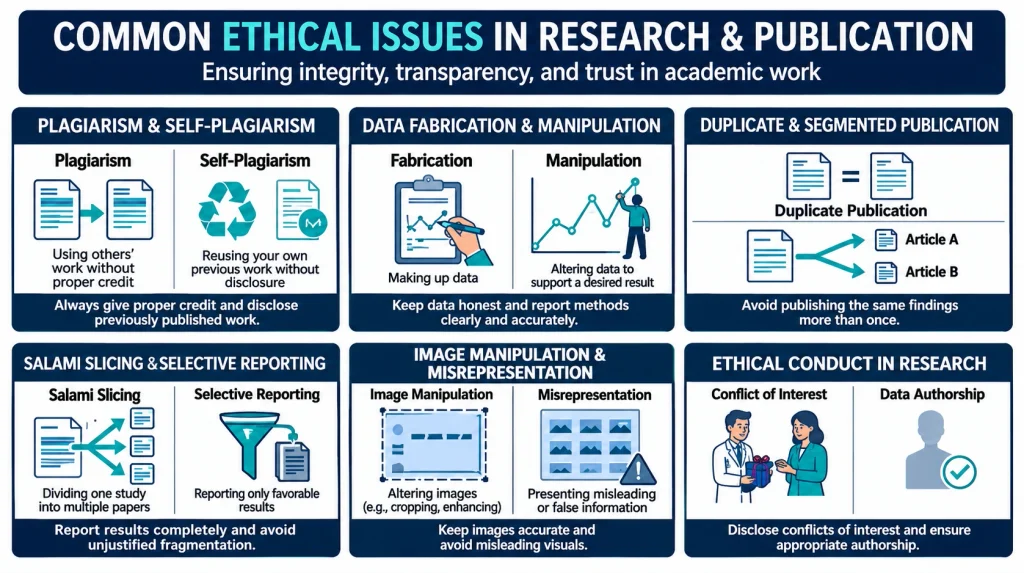
1. Plagiarism and Self-Plagiarism
Using others’ work without credit or reusing previously published work without proper acknowledgement or disclosure.
2. Data Fabrication and Falsification
Inventing research findings or manipulating existing data to misrepresent results.
3. Duplicate and Redundant Publication
Duplicate publication in research ethics means publishing substantially overlapping research more than once without appropriate disclosure or justification.
4. Salami Slicing and Selective Reporting
Responsible publication in research ethics is dividing one study into unnecessarily small publications or omitting unfavorable findings to distort the research record.
5. Image Manipulation and Data Misrepresentation
Altering research images or presenting figures in ways that misrepresent the original findings.
6. Gift and Ghost Authorship
Gift authorship credits someone who did not make a qualifying contribution, while ghost authorship omits someone who did.
Authorship, Contributions, and Conflicts of Interest
Who Qualifies as an Author?
An author should make a substantial contribution to the research, participate in drafting or revising the manuscript, approve the final version, and accept accountability for the work. Gift and ghost authorship are examples of unethical authorship practices.
Acknowledging Research Contributions
Researchers should acknowledge individuals who contributed to the study but do not meet authorship criteria, such as research assistants, technical staff, and editors. Clear acknowledgements support transparency and responsible publication in research ethics.
Disclosing Funding and Conflicts of Interest
Authors should disclose all relevant funding sources, financial relationships, and personal or professional interests that could influence their research. Transparent declarations strengthen research integrity and publication ethics.
Ethical Responsibilities When Preparing a Research Manuscript
Once data are collected, publication ethics governs how findings are reported. Authors must describe methods accurately, report results honestly, including unfavorable ones, and avoid overstating conclusions.
Correct Reporting and Proper Referencing
Ethics in research and publication also covers proper citation. Plagiarism means using another person’s ideas, words, or results without credit. Self-plagiarism means reusing your own previously published work without disclosure.
Research and publication ethics require accurate authorship. Authorship should reflect substantial contribution, accountability, and approval of the final version, not seniority, funding, or favor. Contributors who do not meet authorship criteria belong in the acknowledgments.
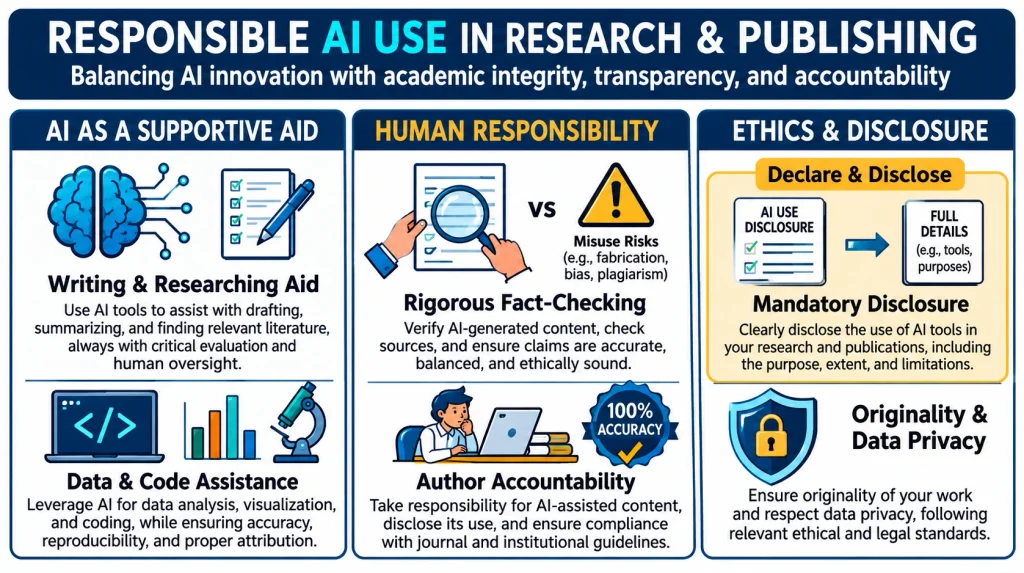
Responsible Use of AI in Academic Publishing
Research integrity and publication ethics also extend to AI tools. If AI assisted with writing, analysis, or code, authors should disclose this where journal policy requires it, while remaining responsible for the final content.
Tables, figures, and images must accurately represent the data. Manipulating images to exaggerate effects, selectively cropping results, or mislabeling data violates research integrity and publication ethics.
Publication Ethics During Journal Submission and Peer Review
1. Ethical Responsibilities During Manuscript Submission
Submitting a manuscript carries its own ethical duties. Work must be original and not under consideration elsewhere, duplicate publication in research ethics begins with simultaneous submission to multiple journals.
2. Peer Review Confidentiality and Reviewer Responsibilities
Authors must disclose related manuscripts, prior publications of the same data, and any conflicts of interest. Common ethical issues in research and publication at this stage include failing to disclose overlapping work or submitting to a journal with a conflicting interest.
3. Editors’ Responsibilities in Maintaining Publication Ethics
During peer review, authors should respond honestly to reviewer comments, maintain confidentiality, and avoid pressuring or influencing reviewers inappropriately. Responsible publication in research ethics means engaging with criticism professionally, not defensively.
If an ethical concern arises, such as a suspected error or misconduct, authors should report it accurately rather than conceal it.
Ethics in Medical, Public Health, and Online Research
Ethics in medical research and publication carries additional protections because participants may face physical or psychological risk. The Declaration of Helsinki and WHO/CIOMS guidance require informed consent, risk minimization, and special care for vulnerable groups.
Ethics in public health research often involves population-level data, where individual consent may be impractical, but privacy protections remain essential. Ethical issues in public health research include balancing public benefit against individual privacy and ensuring equitable inclusion.
Ethical issues in social media research for public health are growing as researchers use online data to study health behavior. Publicly accessible does not mean ethically unrestricted, expectations of privacy, potential harm, and platform rules all matter.
How to ethically research public professional profiles requires assessing context, minimizing identifiable information, and avoiding misrepresentation. A public profile does not erase a person’s reasonable expectation of privacy.
A public documentary on the history of research ethics can be a useful teaching resource, but researchers should still verify its claims against primary sources such as the Declaration of Helsinki and COPE guidance.
Responsible Publication in Practice
What is publication ethics in research in day-to-day terms? It means keeping good records, managing data responsibly, and documenting every approval and consent process.
Ethics in medical research and publication requires extra diligence here, clinical data, consent forms, and adverse-event records must be preserved and accessible. Ethics in public health research similarly demands careful data governance, especially with population-level or identifiable information.
Practical steps include maintaining a research log, backing up data securely, confirming each co-author’s contribution in writing, disclosing funding and conflicts, checking manuscript originality, and choosing a journal whose scope and policies fit the work.
When Publication Ethics Are Violated?
Corrections, Expressions of Concern, and Retractions
Corrections address errors, expressions of concern highlight unresolved concerns, and retractions withdraw unreliable findings from the scholarly record, supporting research integrity and publication ethics.
Possible Consequences of Research Misconduct
Violations involving plagiarism, duplicate publication in research ethics, or other common ethical issues in research and publication may result in manuscript rejection, institutional investigations, reputational damage, or restrictions on future submissions.
Research Publication Ethics Checklist for Authors
Hypothetical example 1:
A researcher submits the same manuscript to two journals simultaneously. This is dual submission, a form of duplicate publication in research ethics, and violates most journal policies.
Hypothetical example 2:
A senior colleague is added as an author despite no meaningful contribution. This is gift authorship and violates responsible publication in research ethics.
Hypothetical example 3:
A researcher omits an unfavorable result to strengthen the conclusion. This is selective reporting and misrepresents the evidence.
Hypothetical example 4:
A study uses identifiable social media posts without considering privacy expectations. This raises ethical issues in social media research for public health and may require consent or anonymization.
Hypothetical example 5:
An author discovers an error after publication. The right response is to contact the journal promptly and request a correction, not to ignore it.
End Note
Research publication ethics is not a barrier to publishing, it is what makes published research trustworthy. By planning ethically, writing honestly, submitting transparently, and correcting errors openly, authors protect participants, colleagues, and the integrity of science itself.
Frequently Asked Questions
Research ethics protects participants during the study. Publication ethics governs how findings are reported, reviewed, and published. Research publication ethics connects both across the full research lifecycle.
The most common ethical issues in research and publication include plagiarism, data fabrication, falsification, duplicate publication, improper authorship, and undisclosed conflicts of interest. These practices can undermine research integrity and reduce trust in published findings.
No. Simultaneous submission is generally prohibited and can lead to rejection or sanctions under duplicate publication in research ethics policies.
Publication misconduct can lead to retractions, manuscript rejection, institutional investigations, reputational damage, and loss of research credibility.
Researchers should follow research ethics guidelines, report findings honestly, acknowledge all contributors, disclose conflicts of interest, and follow journal publication policies.
Many journals now require it. Check the specific journal’s policy, research integrity and publication ethics increasingly cover AI transparency.
Contact the journal editor promptly. A correction is usually appropriate for a small honest error; more serious issues may require further action under publication ethics guidance.
Discuss contributions early, agree on authorship in writing, and revisit it during the project. If a dispute arises, involve the institution or journal’s ethics process rather than resolving it unilaterally.